A target market is the specific group of people a business sells to, defined by shared traits like demographics, location, needs, behavior, and buying power.
A business that tries to sell to everyone usually ends up selling to no one. A target market narrows the focus. It defines exactly who the business serves so every product decision, marketing message, and sales conversation can be built around those people. The clearer the target market, the easier it becomes to win the customers worth winning.
What Defines a Target Market?
A target market is the segment of the broader population most likely to buy from a business. Defining it means looking at the traits that group those customers. These are the most common factors:
- Demographics: age, gender, income level, education, occupation, family status
- Geographics: city, neighborhood, region, or service area
- Psychographics: values, interests, lifestyle, attitudes, priorities
- Behavior: buying frequency, brand loyalty, product usage, price sensitivity
- Needs and problems: the specific challenge the business solves for that group
The strongest target market definitions combine several of these. For example:
A local bookkeeping firm might define its target market as small business owners with under 20 employees, operating in the Dallas–Fort Worth area, who feel overwhelmed by quarterly tax filings. That definition shapes every marketing decision that follows.
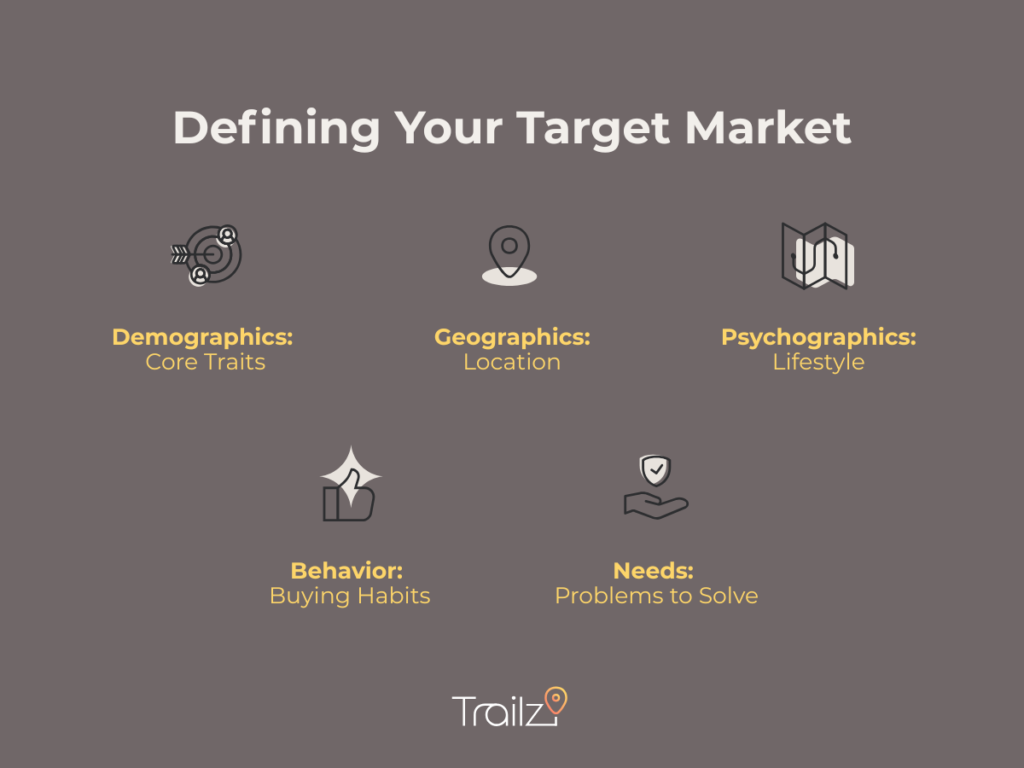
to effectively define your business’s target market.
Why Does a Defined Target Market Matter for a Business?
A target market shapes nearly every operational decision a business makes. Without one, the business spreads itself thin trying to appeal to everyone.
A defined target market helps the business:
- Write product descriptions and service pages in language the right customers actually use
- Choose marketing channels that the target market actually spends time on
- Set pricing that aligns with what the target market is willing and able to pay
- Build features, services, and offerings around real customer needs instead of guesses
- Spend marketing budget on the audiences most likely to convert
A small business with a clear target market routinely outperforms a larger competitor trying to be everything to everyone. Specificity beats scale at the small business level.
How Does a Business Identify Its Target Market?
The target market emerges from a combination of customer data and honest evaluation of who the business serves best. The most reliable starting points include the following:
- Review the existing customer base for shared traits — the most loyal, profitable, and easiest-to-serve customers usually reveal the target
- Analyze which products or services generate the strongest margins and the happiest customers
- Identify the specific problem the business solves better than competitors, and the people that problem belongs to
- Map the geographic area the business can realistically reach, especially for local businesses
- Test marketing messages against narrower segments and measure which ones convert
A target market is a working hypothesis, not a permanent definition. The strongest businesses revisit and refine theirs as the market shifts.