Marketing brings customers to the business by making it discoverable to people already searching for what it offers. Business development grows the business through direct relationships, partnerships, and opportunities built one connection at a time.
The two functions get used interchangeably, but they do different work and reach different people. Understanding the line between them is the first step to deciding where a business should invest its time, budget, and attention.
Marketing Reaches People Who Are Searching
Marketing is built around visibility. Its job is to make sure the business shows up when someone is looking — whether that search happens on Google, on an AI assistant, on social media, or through a referral that sends someone to the business website. For a local business, marketing means a fully optimized Google Business Profile, customer reviews, hyper-local content, and the local search signals that decide who appears in the Map Pack.
The defining trait of marketing is that it scales through systems. One well-built profile reaches every nearby searcher. One well-written piece of content reaches every reader who lands on it. The work compounds without requiring a new conversation each time.
Business Development Builds Direct Relationships
Business development is built around connection. Its job is to create opportunities that would not exist without a direct introduction, a personal conversation, or a strategic partnership. It is the work of finding referral partners, joining business networks, sitting down with potential clients, and turning relationships into deals.
The defining trait of business development is that it scales through trust. A single relationship with the right partner can deliver more revenue than a year of cold outreach. The work is slower per touchpoint but often more valuable per outcome.
The Tools and Outcomes Look Different
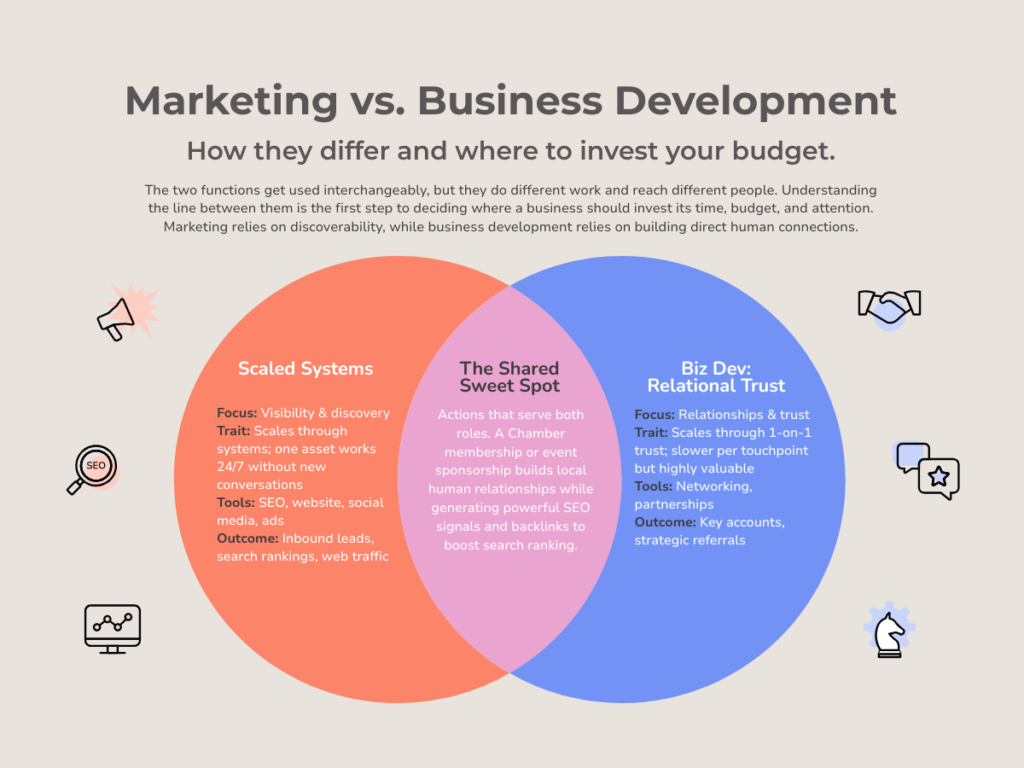
The clearest way to see the distinction is to compare what each function actually does day to day:
- Marketing tools: Google Business Profile, website, SEO, content, reviews, social media, paid ads
- Business development tools: networking events, partnerships, referral agreements, direct outreach, business associations
- Marketing outcomes: inbound leads, brand visibility, search rankings, foot traffic, website conversions
- Business development outcomes: signed partnerships, referral relationships, key accounts, strategic introductions
Marketing fills the top of the funnel with people the business has never met. Business development fills it with people whom someone has made an introduction to.
Where the Two Functions Overlap
A Chamber of Commerce membership is a business development move — it puts the owner in a room with other local business leaders. But the citation that membership creates on the Chamber’s website is a marketing signal that helps the business rank in local search. A sponsorship of a community event is a relationship-building act and a backlink. The most effective small businesses recognize that the same action often serves both functions.