


When someone searches for coffee, pizza, or a haircut nearby, they usually choose from the first few results that appear on the map. Franchise owners know this moment well. It’s where visibility often turns into visits. Even if your brand is well known, people still want to find the nearby branch that feels part of their neighborhood. That’s where search visibility in your area becomes an important advantage.
Studies show that businesses appearing in the top three results on the map get 126% more traffic and 93% more calls, website clicks, and requests for directions compared to those ranked lower. That level of engagement reflects what matters most to customers: trust, relevance, and a sense of connection.
In this post, you’ll learn how search engine optimization and Google Business Profiles can help franchise locations build stronger community ties and stand out within their region—while staying consistent with the brand.
Why Local SEO Matters for Franchise Success
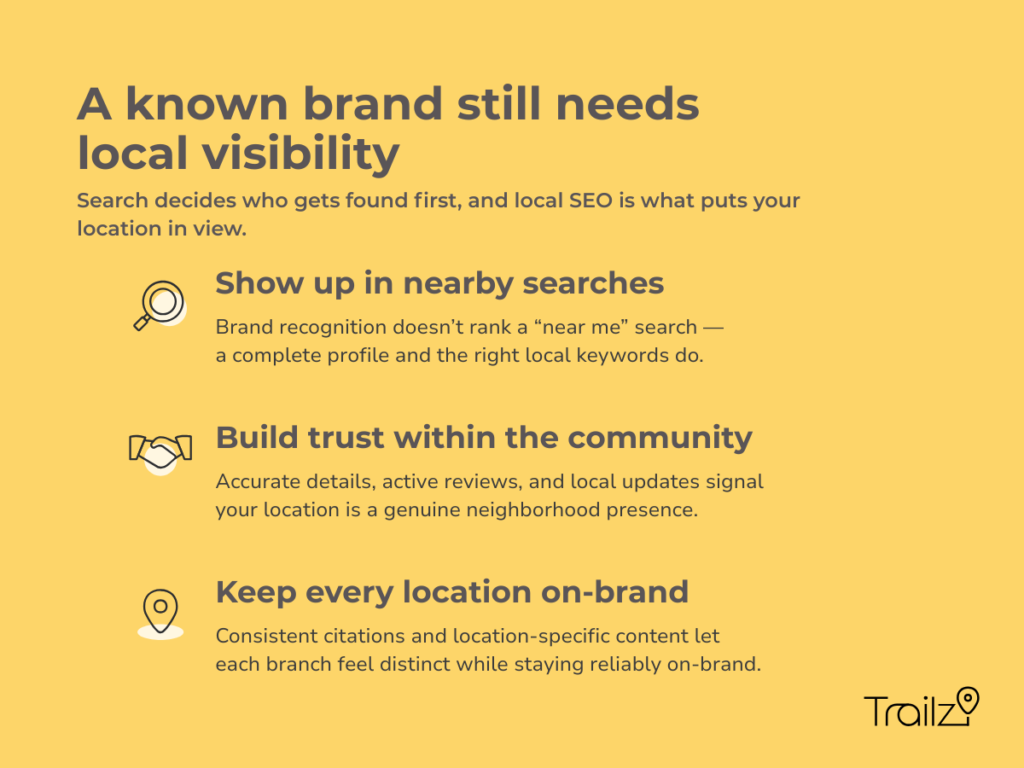
Many franchise owners assume that a well-known brand name is enough to bring in nearby customers. But search behavior tells a different story. People still look for nearby options, and they often choose from the first few listings that appear in search. That’s where local SEO for franchises makes a meaningful difference—it helps your business show up, stand out, and connect with people right where they are.
Here are three key reasons why investing in franchise SEO can help your location grow:
Reason 1: It connects your franchise to real local searches.
Even national brands need visibility in search results. When customers search “near me,” they’re not looking for the corporate website—they’re trying to find the closest location that feels accessible.
Strong SEO strategies such as optimizing your Google Business Profile and using relevant keywords help your store appear in those high-intent searches. For a closer look at what helps a local business stay visible without overspending, see our post on affordable SEO for small businesses.
Reason 2: It helps build trust and loyalty in your community.
Local SEO supports relationship-building. When your location page is accurate, your reviews are active, and your posts reflect what’s happening nearby, people see your business as part of the community. That trust often leads to repeat visits and word-of-mouth recommendations.
Reason 3: It strengthens your overall brand presence.
A consistent SEO for franchises plan—with updated citations, complete contact information, and optimized location-specific content—helps each branch feel unique while maintaining the same reliability customers expect from your brand. Publishing content that’s helpful and hyperlocal can also increase your visibility over time. See our post on how to get blog traffic for tips on creating content that supports your local SEO campaign.
A well-executed local SEO campaign doesn’t just improve your ranking on search engines. It helps your franchise become a trusted, recognizable part of the neighborhood. Trailzi can help you optimize for that kind of authentic, local connection.
Local SEO for Franchisors vs. Franchisees: Who Handles What?
Most franchise systems split local SEO between two groups. Corporate protects the brand, and the franchise owner knows the neighborhood. Both roles matter. Problems start when nobody has written down where one job ends and the other begins.
Here’s a practical way to divide the work:
| Responsibility | Franchisor (corporate) | Franchisee (local owner) |
|---|---|---|
| Profile ownership | Primary owner of each Google Business Profile | Added as a manager for their location |
| Location data | One central record per location (name, address, phone, hours, page URL) | Reports changes to hours, services or staff |
| Brand standards | Sets naming, photo and messaging rules | Applies them to local posts and photos |
| Reviews and updates | Sets the response approach | Asks for reviews, replies and posts local news |
Google’s guidance supports this setup. The business stays the primary owner, and helpers get manager access instead of a shared login. Chains with 10 or more profiles can also verify locations in bulk.
Where the split usually breaks
- Duplicate listings. A franchisee creates a profile without knowing corporate already set one up. Google asks for one profile per location, and duplicates may not show in Search or Maps at all.
- Inconsistent details. A franchisee updates holiday hours on the profile, but the location page still shows the old ones.
- Brand rules that block local updates. When every post waits on corporate approval, the listing goes quiet and loses the local feel customers respond to.
The fix is less about who has more control. It’s about written rules: who can change the source data, who approves big changes like a move or closure, and who confirms that the update reached every listing.
The Benefits of Google Business for Franchises
Franchises often face a unique challenge: standing out locally while staying aligned with a national brand. One of the biggest benefits of Google Business is how it helps each location feel connected to its community, not just part of a chain. With the right setup, your profile becomes more than a listing—it becomes a trusted digital storefront.
Here are four core benefits that franchises need to know:
Benefit 1: You show up in the right search results.
An optimized profile helps your business appear in local map packs and organic listings. This visibility supports more organic traffic and better chances of converting searchers into customers.
Benefit 2: It builds trust through accurate info.
Clear details—like your phone number, address, and open hours—help avoid confusion. When listings are out of date, you risk customer drop-off. Keeping things current also improves your citations across other directories like Yelp.
Benefit 3: You can highlight local relevance.
Photos of your team, seasonal updates, and community events give your listing personality. This kind of content helps distinguish your location from others and shows you’re active in the area.
Benefit 4: It supports your larger SEO strategy.
Your Google Business Profile contributes to good SEO by feeding into your broader content marketing and backlink efforts. When set up properly, it strengthens your conversion funnel and complements your website and blog content.
If you’re unsure how your profile is performing, it may be time for an audit. See our post on getting found on Google for more context—or learn how local SEO supports long-term growth.
Trailzi helps franchises tap into the full benefits of Google Business by optimizing the details that build trust and drive visibility where it matters most.
Use Your GBP to Show Up and Stand Out Locally
A basic listing isn’t enough anymore. If your Google Business Profile looks like every other franchise location, local customers may scroll past it. Showing up in search is the first step—but standing out is what helps build trust and drive action. This section focuses on how to use your GBP to create a local presence that feels authentic, even within a national brand.
Here are three simple ways to make your GBP work harder for you:
1. Post local updates regularly.
Share time-sensitive offers, community events, or seasonal reminders. These updates show that your location is active and responsive. If you’re unsure what kind of updates to prioritize, see our post on building a Google Business strategy for examples that feel natural and engaging.
2. Add photos that reflect your real space and people.
Stock photos don’t build trust. Share pictures of your team, storefront, and even the neighborhood (with permission). This content helps reinforce that your location is part of the community—not just a copy of a national brand.
3. Highlight personal moments.
Recognize staff milestones, feature loyal customers, or showcase your involvement in local causes. These small actions help your location stand out in a crowded search result.
Consistent updates not only support better visibility but can also generate more interest and leads from nearby searches. If you’re trying to attract more qualified traffic, see our post on generating leads for service-based businesses.
Trailzi helps franchises use tools like GBP to show up with clarity—and stand out with purpose.
How Do You Build Local Pages for Franchise Locations?
Give each location its own page under one Locations hub. Fill it with details only that branch can claim, and link its Google Business Profile straight to it.
Sister pages can share a template. They shouldn’t share the substance.
A strong location page usually includes:
- A clear URL: a subfolder such as /locations/texas/flower-mound/ on the main domain. Separate microsites for each franchisee split ranking signals.
- Accurate contact details: that branch’s address, local phone number, and hours, matching the profile exactly.
- Local content: services offered at this location, staff, directions, parking, neighborhoods served, and branch FAQs.
- Real photos and local reviews: the actual storefront, the actual team, and feedback from nearby customers.
- A matching profile and markup: the Google Business Profile links to this page rather than the homepage, and LocalBusiness structured data describes the same business shown on the page.
There’s a quick test for local content. Would most of the page still be true if you swapped in another city’s name? If so, it needs more substance.
That matters because Google treats large sets of near-identical city pages as doorway pages under its spam policies. Those pages may rank lower or be left out of results entirely. A page for a home-services location covering Argyle and Northlake should read like it was written by someone who actually drives those streets.
One exception is a location that travels to customers instead of hosting them. In that case, the page should focus on the areas it serves, and the profile usually hides the street address.
From Corporate to Community—Why Local SEO Gives You an Edge
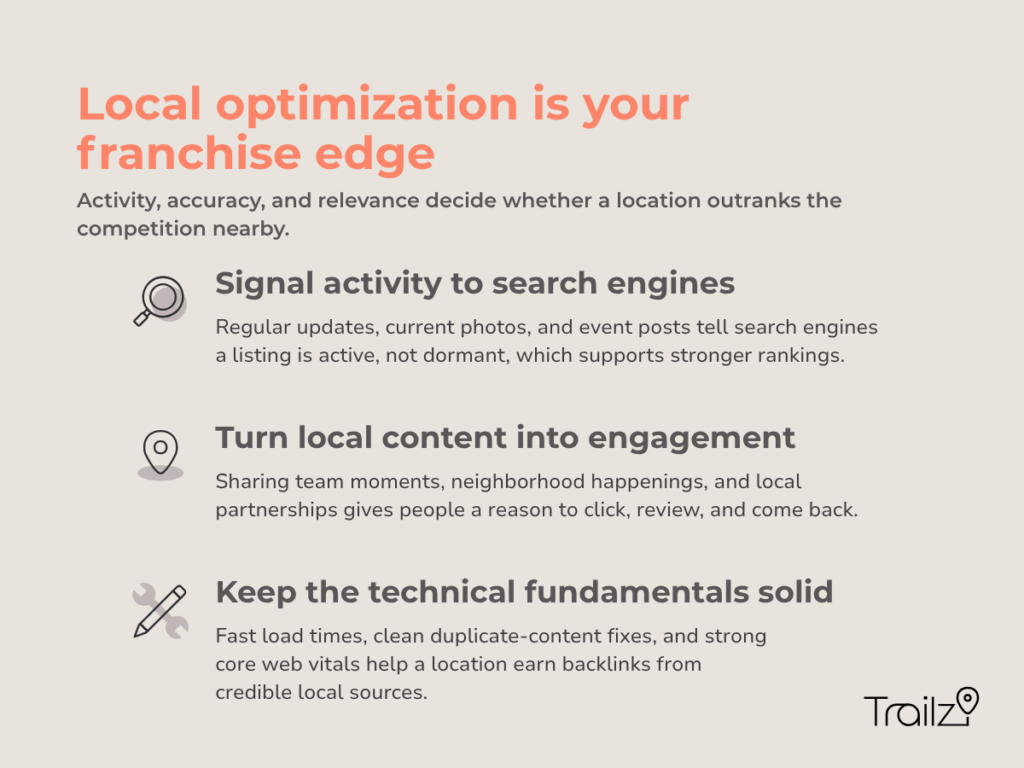
Franchise locations don’t always rank just because the brand is big. Local visibility depends on activity, accuracy, and relevance. That’s why search engine optimization at the location level can help shift your presence from corporate to community. With the right updates in place, your listing can feel less like a directory entry and more like a local staple.
Here’s how local SEO helps franchises gain a competitive edge:
1. Optimization Shows Search Engines That You’re Active
When you regularly update your Google Business Profile with fresh content, photos, and event posts, it signals relevance. Search engines prefer listings that stay current. It also shows that your business is active and engaged with real customers in your area.
2. Community-Focused Content Improves Engagement
Customers are more likely to click, review, and return to a business that feels local. Sharing details about your team, neighborhood events, or partnerships helps people connect with your location. To learn how to shape your updates with purpose, see our post on content strategy for a website.
3. Technical SEO Still Matters For Local Visibility
Page speed, duplicate content cleanup, and core web vitals all influence how each franchise location performs. Clean optimization supports stronger backlinks and helps you get links from credible directories or nearby community sites.
When local pages are well-optimized and relevant, they can perform better than larger competitors—even those with bigger Google Ads budgets. If your profile isn’t leading to calls or clicks, it may be time to refine your local SEO approach.
Trailzi helps franchises use search engine optimization strategies that build visibility and strengthen local connections. You can also see our post on generating more leads for service businesses for practical next steps.
A Local SEO Strategy for Franchises, Step by Step
Posts, photos, reviews, and location pages each help. Done in random order, though, they become a to-do list that never seems to bring in more calls.
Order matters because each step builds on the last. Here’s a sequence a franchise owner can follow:
- Audit what’s already out there. Search for your location on Google, Maps, and the main directories. Look for duplicates, old phone numbers, and leftovers from a move or ownership change.
- Set up one source of truth. Keep a central record for each location, and agree on who can change it.
- Clean up each Google Business Profile. Match the name to your signage with no added keywords, confirm categories and hours, and link to the location page.
- Build or fix location pages. Give each branch details only it can claim.
- Start a steady review routine. Ask every customer and reply to every review. Never filter for happy customers or pay for positive reviews, which federal rules prohibit.
- Measure location by location. Track calls, direction requests, website clicks, and actual leads or bookings for each branch over the same time window.
Google explains local results through relevance, distance, and prominence. Steps two through four support relevance, and step five builds prominence over time. Distance is out of your hands. No one can pay for a better local rank, and placement depends on competition and where each searcher is standing.
The value is in how the steps connect. When a location changes its hours, the central record updates the profile and the page. Measurement then shows whether the work is turning into calls. That’s the difference between doing local SEO tasks and having a local SEO system that works.
Bring Your Brand Closer to Home
Customers may know your brand name, but they choose the location that feels closest—both geographically and personally. Building that kind of connection takes the right SEO support.
Trailzi helps franchises strengthen their online presence through smarter local SEO strategies, community-focused updates, and Google Business Profile optimization. It’s about making each location feel personal, approachable, and easy to find.
Balancing corporate demands with local growth isn’t easy—but you don’t have to do it alone. Reach out today, and let’s bring your franchise closer to the community you serve.