
A small business in Argyle usually isn’t getting found in local search because Google doesn’t have a clear picture of what the business does, where it’s located, or why it should be trusted.
Most small business owners think local search is one thing. Either Google shows you, or it doesn’t. In practice, it’s three things, and almost every business that isn’t ranking has problems in all three at once. Understanding what those three things are can help search engines show your business to your target audience.
How Google Decides Which Businesses Show Up in Local Search
Google ranks local businesses on three factors:
- Relevance. Does Google understand what this business actually does?
- Distance. Does Google know where the business is, and is that location close enough to the searcher?
- Prominence. Does Google trust this business enough to recommend it?
A business that’s strong in all three shows up. A business weak in one usually doesn’t. A business weak in two or three is almost never found. Almost every visibility problem comes back to one of these.
What Causes Google to Not Understand What the Business Does
This is the relevance problem, and it’s the most common reason a small Argyle business doesn’t show up. Google needs clear, specific information about what the business does. When that’s missing, the business loses every search where someone is looking for a specific service.
A few of the most common gaps:
- The wrong primary category on the Google Business Profile. A plumber whose primary category is set to “Contractor” misses every search for “plumber.” Categories are the single biggest relevance signal Google reads.
- An empty or thin services section. Each named service is a chance to match a search. A profile listing only “plumbing” misses searches for “water heater repair,” “drain cleaning,” or “emergency plumber.”
- A vague business description. Phrases like “exceptional service” and “trusted experience” give Google nothing. The description should name what the business actually does and where it serves.
- A website that doesn’t say what the business does. A homepage built around marketing language instead of clear service descriptions leaves Google guessing. Service pages with specific, searchable terms work much better.
Fixing relevance isn’t complicated. But it requires writing the profile and website in the language customers actually search with.
What Causes Google to Be Unsure About the Business’s Location
Distance is where a lot of small businesses lose ranking without realizing it. Google needs to know exactly where the business is and what area it serves, and those signals have to be consistent everywhere.
The location problems most often show up in these places:
- An unverified Google Business Profile. A profile that hasn’t been verified doesn’t fully appear in local search. Plenty of small business owners create a profile but never complete verification, and then wonder why they’re invisible.
- Inconsistent name, address, and phone across the web. The information on Google must match the website, Facebook, Yelp, and every other directory the business appears in.
- A wrong service area. Set too narrowly, the business misses customers in nearby neighborhoods like Harvest or Canyon Falls. But if it’s set too widely, Google treats it as spam. The setting should reflect where the business actually serves customers.
- A website with no local content. Pages that don’t mention Argyle, name local neighborhoods, or reference local landmarks give Google no location signal beyond the profile itself. A website that could be anywhere doesn’t reinforce where the business is.
When these signals line up, Google places the business correctly on the local map.
What Causes Google to Not Trust the Business Enough to Recommend It
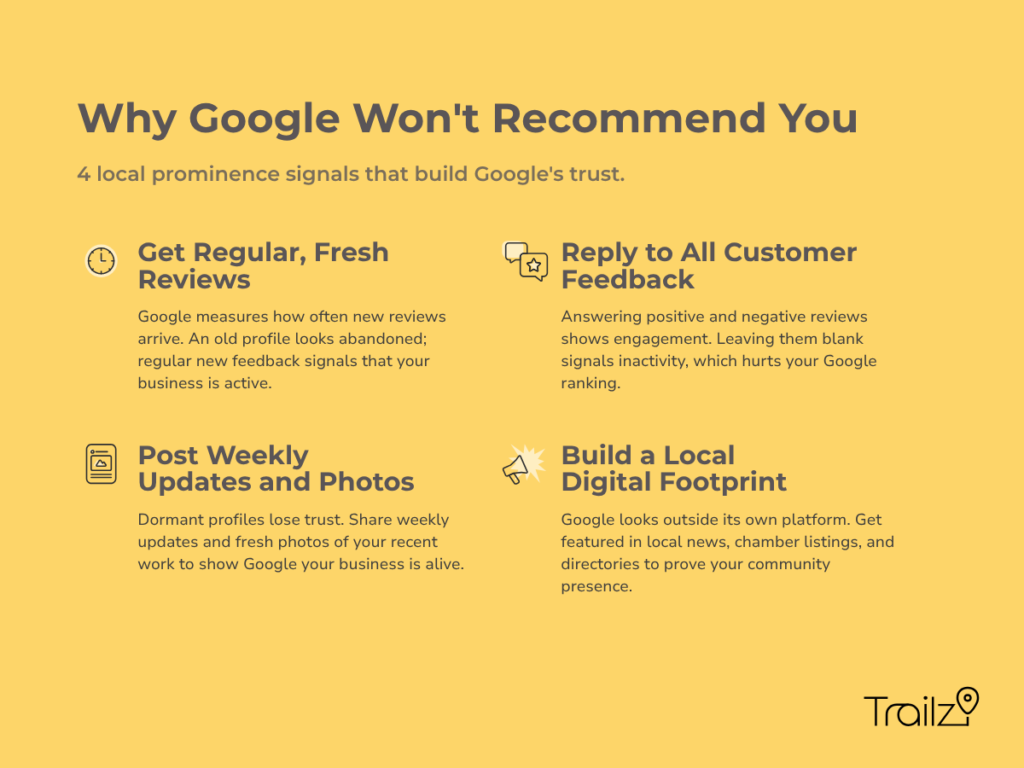
Prominence is the third factor, and it’s the one that takes the longest to fix because it can’t be built overnight. Google reads dozens of signals to decide whether a business is well-known and worth recommending.
The most important ones for small businesses:
- Review volume and recency. A business with a handful of reviews from years ago looks abandoned. A business with regular new reviews looks active. Google reads how often new reviews come in, not just the total count.
- Responding to reviews. A profile where every review goes unanswered signals an inactive business. A profile where the owner replies regularly to both positive and negative reviews signals engagement. That engagement factors into ranking.
- Posts and photos on the profile. A profile with no recent posts and old photos looks dormant. A profile with weekly posts about community events and fresh photos of recent work looks alive.
- Mentions across the web. Local publications, the Argyle Chamber of Commerce, partnerships with other local businesses, and listings on authoritative directories all build the picture Google uses to decide who’s known in the community. A business with no presence outside Google looks less established than one with a wider local footprint.
Prominence builds over time. A small business that consistently does the work for six months ends up in a different ranking position than one that tries it for a week and stops.
What Argyle’s Growth Means for Local Search
Argyle’s growth changes the local search landscape in two ways at once. The number of searches is going up as new residents arrive. So is the number of businesses competing for those searches.
A small business that ranked well two years ago might not rank well today, even if nothing about the business changed. The bar has moved. More competitors, sharper profiles, more reviews, and more local content all raise the threshold for showing up.
Argyle is still small enough that focused effort can make a huge difference. The businesses that fix the three factors before the market gets more competitive will hold their position. And the ones that wait will be trying to catch up against businesses already doing the work.
What Fixing This Actually Looks Like
A small business not getting found in Argyle usually has weak signals across all three ranking factors. Improving one helps a little. Improving all three is what actually changes search visibility.
That means a fully optimized Google Business Profile with the right categories, complete services, accurate location, and active engagement. A website that names what the business does, where it operates, and what it offers in the language customers use to search. And a wider web presence that confirms the business is real, established, and trusted in the local community.
The pieces work together. None of them work alone.