
A small business can tell if it has a marketing or sales problem by mapping the full funnel from both sides and evaluating each step for quality.
Every small business owner has felt this frustration. Leads come in but don’t close. Or leads don’t come in, and everyone points fingers. Marketing says sales isn’t converting the leads. Sales says the leads aren’t good enough. Neither side is entirely wrong, but neither knows where the actual issue lives.
The only way to answer the question honestly is to look at the full funnel. Starting from the moment a stranger first hears about the business to the moment they become a paying customer, and evaluate every step for quality.
Why the Marketing vs. Sales Blame Game Happens
The blame game shows up in businesses of every size. Marketing teams see the leads they generated and don’t see what happened after those leads got passed to sales. Sales teams see the leads they got and don’t see how those leads were sourced or qualified. Each side has only half the picture.
That’s why the argument keeps going in circles. Marketing insists lead volume is up. Sales insists lead quality is down. Both can be true at the same time, but neither team has the visibility to prove it.
The friction itself is useful information. It usually means the funnel isn’t being tracked end-to-end. When one team can see the whole process, the argument stops being about opinion and starts being about data.
How to Map the Full Funnel from Both Sides
The diagnosis starts with mapping the process. Marketing writes down every step it takes to generate a qualified lead. Sales writes down every step it takes to convert that lead into a customer. And then both maps get laid out together.
Most teams discover the two sides have been assuming different definitions of “qualified lead” or different expectations about response time. The map surfaces those disconnects immediately.
Then each step gets evaluated for quality:
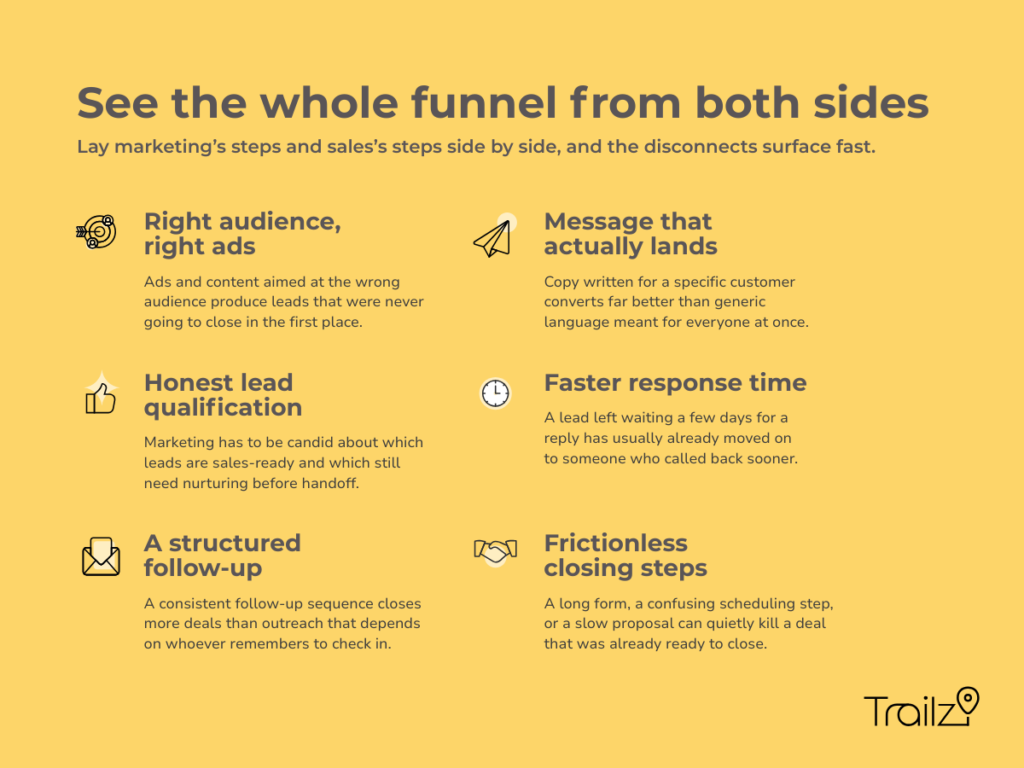
- Audience targeting. Ads and content that reach the wrong audience generate leads that were never going to convert.
- Message clarity. Language that speaks to the target customer converts better than generic copy aimed at everyone.
- Lead qualification. Marketing needs to be honest about which leads are ready for sales and which need more nurturing before being handed off.
- Response time. A lead that waits three days for a follow-up is often a lead that has already moved on.
- Follow-up process. A structured sequence closes more customers than sporadic outreach that depends on whoever remembers to check in.
- Closing steps. Simple friction — a form that’s too long, a scheduling process that’s confusing, a proposal that takes a week to send — can kill deals that were otherwise ready to close.
Working through these steps usually reveals where the issue lives, and it’s rarely where either team assumed.
Set Quality Controls Around the Funnel
Once the funnel is mapped, quality controls turn what a subjective argument into a measurable process. Quality control is a metric or standard that indicates whether each step is being executed as agreed. Response time gets tracked. Lead source quality gets tagged. Follow-up sequences get logged.
When something breaks, the data shows where. Marketing can see if the leads they generated met the criteria the two teams agreed on. And sales can see if the follow-up process was executed correctly.
Identify Where Money Is Being Spent on Low-Quality Acquisition
The most valuable outcome of this process is usually financial. Once the funnel is mapped and controlled, it becomes obvious what steps of the funnel are overspending against your customer acquisition budget.
Some ads bring in high volumes of leads that never convert. Some lead sources look expensive at first but produce a much higher ad conversion rate and lower cost to acquire real customers. Without funnel mapping, this level of clarity is impossible.
How Quality Controls Turn a Blame Game Into a Business System
The bigger shift is cultural. When both teams can see the full funnel and the quality controls at each step, the argument between marketing and sales tends to fade. It’s replaced by shared responsibility.
That doesn’t mean the tension disappears entirely. Marketing and sales still see the world differently, and that’s healthy. But the debate stops being about who’s failing and starts being about how to improve the process together. That shift is what separates businesses that grow steadily from ones that get stuck in the blame cycle for years.

What This Means for a Small Business
Small businesses can’t afford to waste marketing spend on low-quality lead generation or lose deals to slow follow-up. Every dollar has to produce marketing ROI. And the fastest path to that is a funnel with visibility at every step.
Once the process is clean and consistent with a primary target customer, the same framework can be used to test tangential audiences. A strategy that reliably produces conversions with one customer type can be applied to nearby customer types to see if the same approach works. But without a proven baseline, that testing is guesswork.
This is often where a small business marketing agency adds real value. Diagnosing funnel problems and setting up quality controls is a specific skill, and it’s the kind of work that pays for itself quickly by identifying where marketing budget is being wasted.