
A Google Business Profile that isn’t generating calls is usually being treated as a listing, when Google expects it to be an active marketing channel.
Most small businesses set up a Google Business Profile once, fill in the basics, and treat it as done. Then they wait for the calls. But when the calls don’t come, the natural assumption is that something must be broken — the profile, Google, or local search itself. Usually nothing is broken. The profile is doing exactly what a static listing does. It sits there waiting to be found, then offers nothing compelling when it is.
Google has been clear about what an effective profile actually looks like. The company publishes guidance directly, through monthly bulletins, industry-specific playbooks, and a dedicated YouTube channel. Most small businesses haven’t read any of it.
What Google Expects from a Small Business Profile
Google’s expectation is that the business has a strategy and uses the tools Google provides. Profiles that show real activity get surfaced more often than profiles that sit still.
This is where most small businesses lose ground. They tune up their profile based on whatever advice they happen to read — blogs, SEO influencer content, podcasts, conference takeaways. Some of that content is good. A lot of it is recycled from 2020. So it misses what’s new or focuses on tactics that don’t drive calls.
Google publishes the answers directly. Working from the source produces sharper results than working from secondhand interpretation.
What’s in Google’s Small Business Bulletin
In May 2026, Google released a small business bulletin tied to Small Business Week. It included strategies for small businesses across industries, with detailed playbooks for the categories that drive the most local search:
- Restaurants and cafes
- Hotels and accommodations
- Tour and activity operators
- Service-based businesses
- A general playbook for businesses that don’t fit any of the above
Each playbook is a working framework. The restaurant playbook covers what to post, what photos drive bookings, and how to handle reservations through the profile. The service business playbook covers how trades and licensed professionals should structure their information to match the searches their customers actually run.
A business that reads its category’s playbook and follows it has a real advantage over a competitor who’s never seen it. The information is public. The execution gap is the opportunity.
How to Prepare a Google Business Profile for Real Demand
The same bulletin included an example built around the 2026 World Cup. It wasn’t about soccer. It was about preparing a profile for an upcoming event with a known demand spike.
The technique applies to any moment a business cares about, like a holiday weekend, a graduation week, a town festival, a tax deadline, a seasonal service rush. These are moments when customers search with high intent and decide quickly. The profile that’s ready for those moments captures the calls.
Preparation covers the obvious things, like accurate hours and fresh photos that reflect what customers will encounter. It also covers the piece most businesses skip. And that is using Google Posts to actively signal what’s happening and give customers something to click.
Why Google Posts Are the Conversion Driver Most Businesses Ignore
The bulletin’s webinar emphasized Google Posts specifically.
Posts are how a Google Business Profile stops looking like a listing and starts behaving like a digital marketing channel. They appear in the local panel and on Maps. They tell Google the business is active. They give customers something to engage with beyond the basic information, and each one includes a call-to-action button (e.g., Book, Order online, Buy, Learn more, Sign up, or Call now).
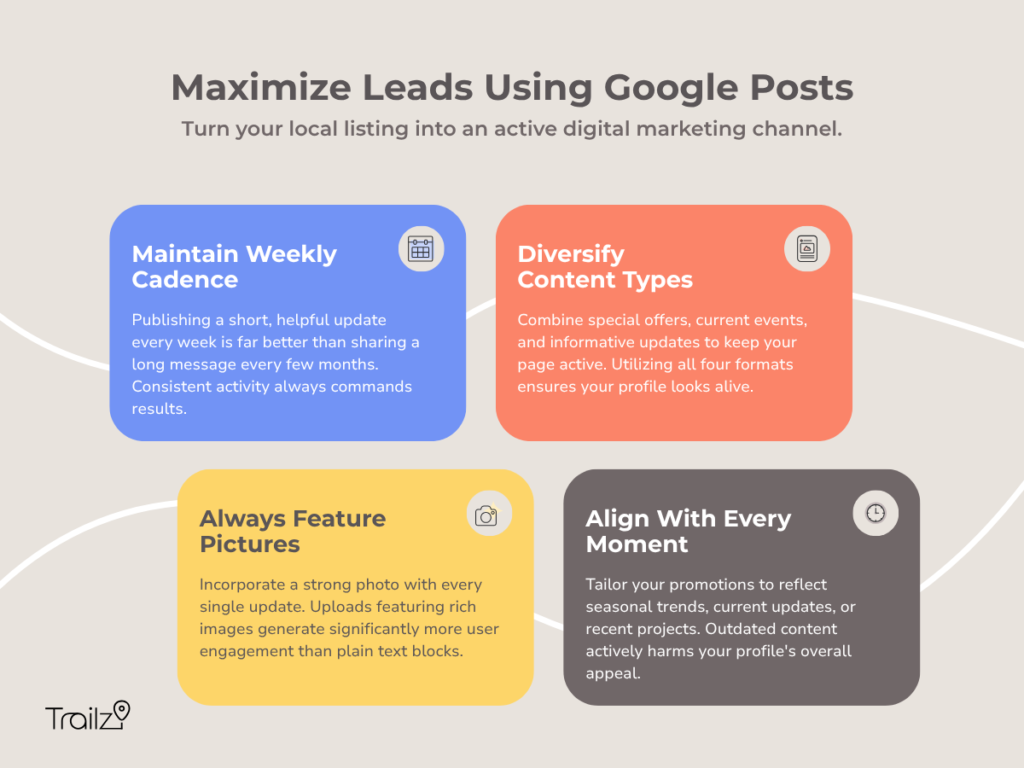
The businesses that get this right do four things consistently:
- Post at least once a week. Cadence matters more than length. A short, useful post every week beats a long one every other month.
- Mix the types. Updates, offers, events, and useful information each serve a different purpose. A profile that uses all four looks alive.
- Include a photo every time. Posts with images get noticeably more engagement than text-only posts.
- Match the post to a current moment. Seasonal offers, current promotions, upcoming events, recent work. Old posts hurt the profile.
The compounding matters here. One post doesn’t change anything. Fifty-two posts over a year, sitting on a profile that customers see at the moment they’re searching, change the conversion significantly.
How to Move from Static Profile to Active Marketing Channel
A Google Business Profile generates calls when it operates as a marketing channel rather than a static listing. The shift takes a few weeks to set up and ongoing attention to maintain. The underlying principle is that Google publishes the playbook, and the small businesses that read it and execute see marketing ROI.
The starting point is going to the source. Google’s small business bulletins, the industry playbooks, the official YouTube channel for Google Business Profile, and the help documentation are all free and public. The businesses winning at local marketing in 2026 are reading them.