
Small businesses often struggle with inconsistent branding, weak local visibility, poor follow-up, and marketing that lacks clear positioning.
Most businesses are already posting on social media, running occasional ads, or asking for referrals. The issue is usually that the marketing activity does not connect to a system that consistently generates visibility and trust. Many small businesses also spread attention too thin across platforms without strengthening the channels that drive the highest buying intent first.
Why Is Inconsistent Branding a Common Marketing Mistake?
Many small businesses change messaging constantly depending on the platform, promotion, or season. The website says one thing, Instagram presents another style, and the Google Business Profile describes completely different services.
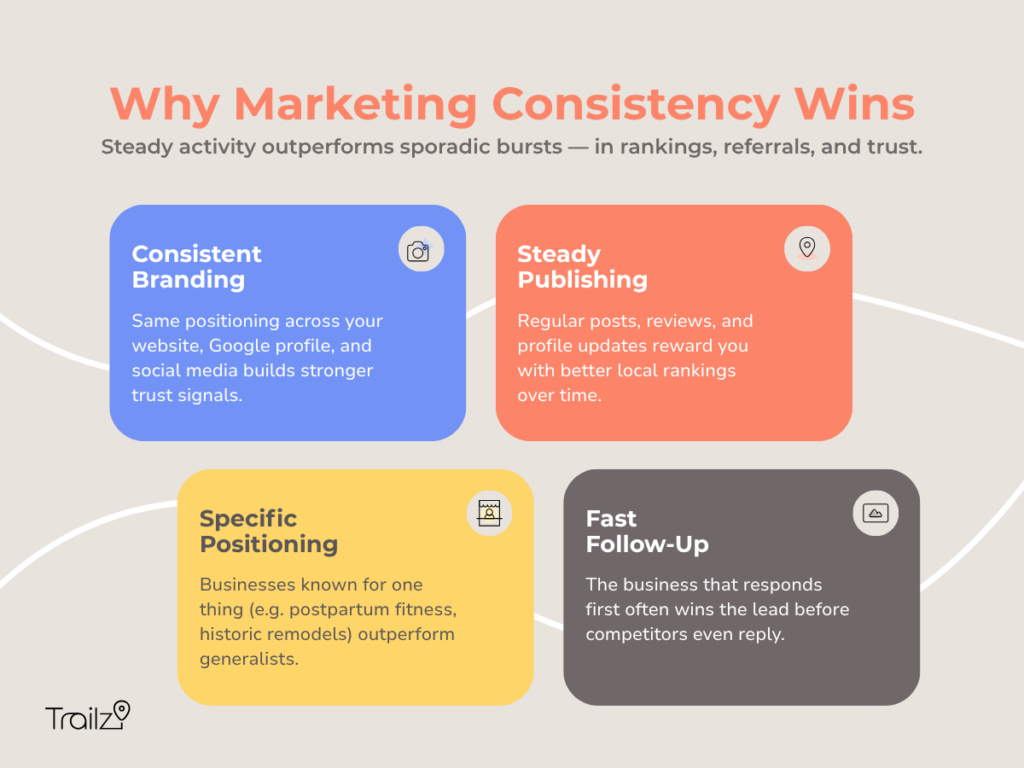
That inconsistency weakens trust signals. Businesses with stronger local visibility usually reinforce the same positioning across every channel. A roofing company focused on insurance restoration, a med spa known for natural-looking injectables, or a wedding photographer specializing in luxury venues tends to perform better than businesses trying to appeal to everyone at once.
Clear positioning also improves marketing efficiency.
Why Do Small Businesses Struggle With Marketing Consistency?
Marketing inconsistency is one of the biggest reasons small businesses plateau after early growth. Many owners market aggressively during slow periods, then stop once business picks up again. That pattern creates uneven visibility and weakens long-term momentum.
Local rankings, social engagement, and referral activity tend to reward consistency over occasional bursts of activity. Businesses that maintain steady publishing schedules, review generation, and profile updates usually build stronger long-term visibility than competitors relying on sporadic campaigns.
How Does Poor Follow-Up Affect Small Business Marketing?
Many marketing problems actually happen after the lead arrives.
A business may invest in SEO, paid ads, or social content successfully but still lose opportunities through slow response times or inconsistent follow-up.
Common problems include:
- Contact forms with delayed responses
- Missed calls during business hours
- No automated inquiry confirmation
- Unclear next steps after submission
- Inconsistent lead tracking
Small businesses sometimes focus heavily on lead generation while underestimating how much conversion depends on speed and communication. In local markets, the business that responds first often wins the conversation before competitors reply.

Why Do Generic Marketing Messages Underperform?
Generic marketing language makes it difficult for small businesses to separate themselves in crowded local markets. Phrases like “high-quality service,” “customer satisfaction,” or “trusted professionals” appear across thousands of websites and profiles. They rarely communicate why one business deserves attention over another nearby competitor. More effective businesses usually market through specifics.
A remodeling company may highlight experience with historic homes in older neighborhoods. A fitness studio may focus on postpartum training. A law firm may emphasize experience with contractor disputes rather than general business law. Specific positioning strengthens both search relevance and customer trust because the business appears more closely aligned with the exact problem being searched.