Most small businesses spend 7% to 12% of revenue on marketing, with the strongest returns coming from Google Business Profile and local SEO.
For a small business, the right marketing budget is not a fixed dollar amount. It is a percentage of revenue calibrated to growth stage, competition, and where the spending is directed. The businesses that get the strongest return tend to invest in the channels that capture customers already searching for what they sell.
Small Businesses Typically Spend 7% to 12% of Revenue on Marketing
The benchmark works because it accounts for real-world variation. Newer businesses and those in competitive markets typically sit at the higher end, since building awareness from scratch costs more than maintaining it. Established businesses with steady demand can operate closer to the lower end. The right number for any given business is the one that supports the growth the business wants.
The bigger question isn’t how much to spend — it’s where. A small business directing modest dollars at high-intent local channels often outperforms a competitor pouring far more into broader campaigns.
Local Marketing Delivers the Most Predictable Return on a Small Business Budget
The local marketing budget tends to outperform other spending because customers are already there. Most local searches happen on Google. So the top listings collect the majority of the clicks. And many searchers buy within 24 hours. Budget directed at ranking in that top group reaches customers actively making decisions.
That’s what makes local SEO the most cost-effective channel for a small business. National ad campaigns spread spending across audiences who may never become customers. A local marketing investment focuses every dollar on the people most likely to walk in, call, or convert within a day.

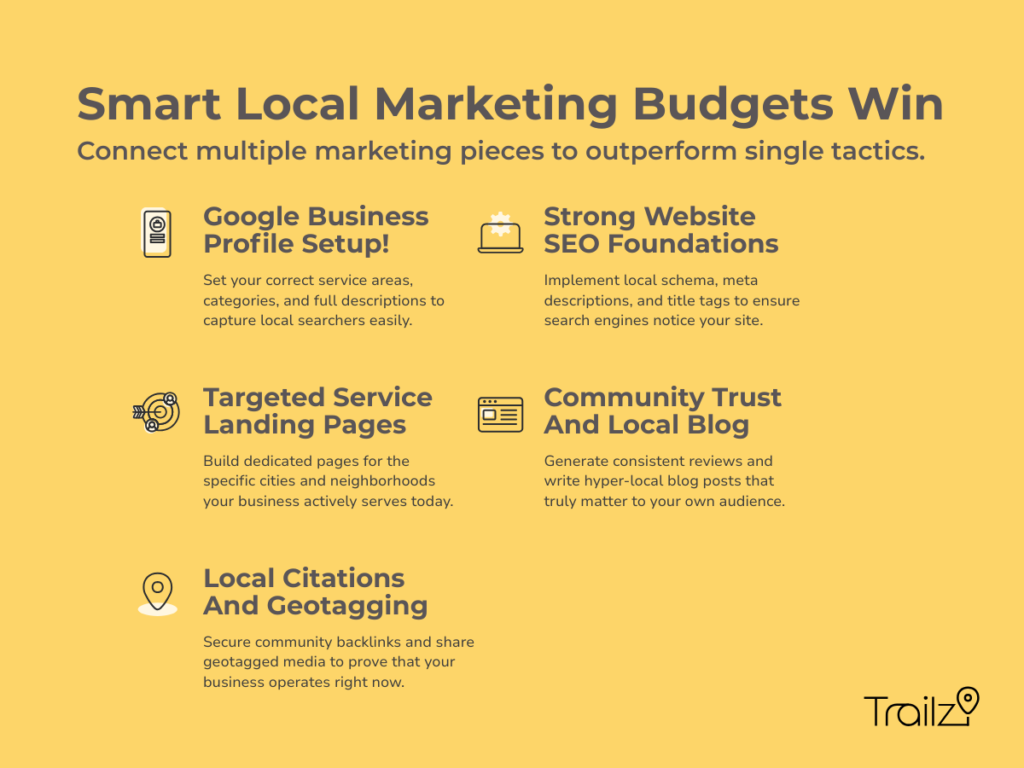
A Working Local Marketing Budget Covers Multiple Connected Pieces
A working local marketing budget supports several connected components:
- Google Business Profile optimization, including service area sizing, category setup, and a fully written services section
- Website foundations like meta descriptions, title tags, alt text, and local schema
- Service area landing pages built around the cities and neighborhoods served
- Hyper-local blogs about what matters in the region
- Backlinks and citations from community involvement, like Chamber memberships and local sponsorships
- Review generation systems that make leaving a review easy and consistent
- Geotagged photos and videos that prove the business operates where it claims to
Each piece reinforces the others. Which is why the budget allocated across these areas tends to outperform a budget concentrated in a single tactic.