


We are often asked what good marketing costs. Most people expect to hear a number that makes them wince—something like $8,000 a month. But here is the reality: It doesn’t. If you think you need a massive war chest to compete with the big franchises, you are paying an “Invisible Tax.” This is the cost of staying stuck in old ways of doing things while the world moves forward. I have seen companies dominate their local markets starting with as little as $500. This book is about how you close that gap.
The “Work Harder” Trap
There is nothing more frustrating for a professional—the better plumber, the more experienced builder, the more compassionate counselor—than watching a lesser competitor sit at the top of Google.
You’ve been told that if you just do great work, the business will follow. That used to be true. But today, being the best at your craft isn’t enough to win. If you are relying on manual effort and hope while your competitor uses an automated system to capture every lead and review them, you are essentially invisible.
Pro Tip: Check Your Reality
There is nothing more frustrating for a professional—the better plumber, the more experienced builder, the more compassionate counselor—than watching a lesser competitor sit at the top of Google.
You’ve been told that if you just do great work, the business will follow. That used to be true. But today, being the best at your craft isn’t enough to win. If you are relying on manual effort and hope while your competitor uses an automated system to capture every lead and review them, you are essentially invisible.
The Mathematical Reality of 2026
Let’s talk about the $12,000 Project.
In the past, building real authority for a specific service—like “IT Outsourcing in Dallas”—required a massive amount of manual labor. You had to pay a human to manually type five blogs, design a landing page, write an ebook, and build an email drip campaign. If you hired a generalist at a $72k salary to do this, it would take them two months of getting stuck in the weeds to finish.
That is a $12,000 cost for one campaign. This is the Efficiency Gap. You are likely overpaying for marketing by 70% because you are paying for manual hours instead of results. Today, AI helps close that gap, but not in the way most people think. It removes bottlenecks so that the team can move faster and better.
• The Old World: 80% of your budget disappears into manual work like typing, posting, and following up.
• The New World: 20% goes to automated execution, leaving 80% for strategy and growth.
Old World Marketing vs. New World Marketing
| The Old World | The New World |
| Overpaying in exchange for manual labor | Uses more cost-effective, AI-driven systems |
| Most of your budget disappears before your business can grow | Only 20% is used for automated execution |
| Slow progress | Expert results in less time |
| 80% of your budget is used inefficiently | 80% of your budget contributes to business growth |
The Bold Promise
This is not a tech book. It’s a Business Budget Book.
I am going to show you how to buy back your time and your budget by using a Marketing Integrator. An Integrator isn’t a bot; it’s a strategist who trains and guides AI to produce high-end, action-oriented content that actually sounds like you.
Instead of spending $12,000 on that IT project, an Integrator can deliver a more sculpted, professional result for $2,000 to $3,000.
Integrator Insight: AI isn’t here to replace your brand; it’s here to scale your expertise. It allows you to stop being the bottleneck in your own growth, so your business can thrive while you are out in the field doing what you actually love.
The Marketing Integrator
If you are like most local business owners, your desktop is a graveyard of software subscriptions you haven’t touched in months. You were told AI would make marketing easy, but it just gave you another chore to manage.
The problem isn’t the technology. The problem is that you are trying to be the technician, the strategist, and the business owner all at once. You don’t need more tools; you need a Marketing Integrator.
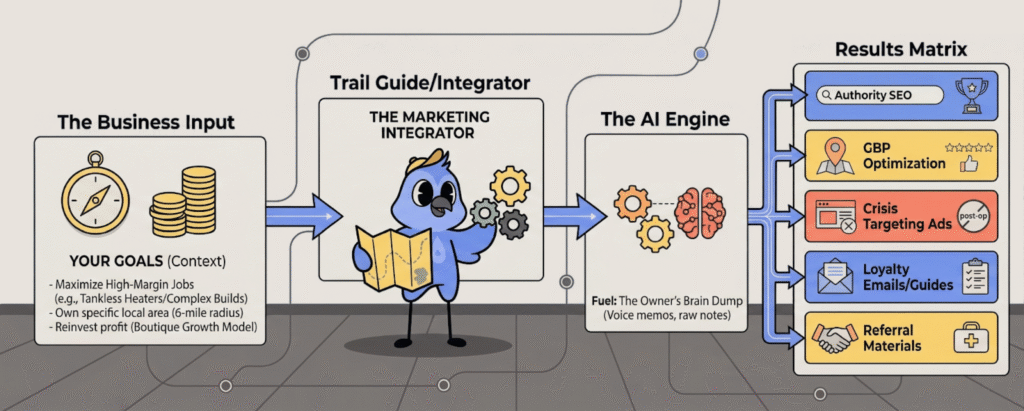
Think of an Integrator as the bridge between your business goals and the tools required to reach them. They aren’t just another freelancer; they are the person who builds and manages your marketing engine so you can get back to your actual work. In this chapter, we define how this role shifts your daily operation from manual labor to strategic oversight.
Moving from Prompting to System Building
Many people believe that prompting is the secret to using AI. A lot of people come in thinking it’s all about the perfect prompt. That if you phrase it just right, everything clicks. This is not true. In fact, relying on one-off prompts is a major mistake for a local business owner.
The problem is that prompting is still a manual chore. If you have to sit at your desk for two hours trying to prompt an AI to sound human, you haven’t actually saved any time. You have just traded one manual task for another. Instead of being a business owner, you’ve given yourself a new part-time job as a copywriter.
The Marketing Integrator moves you away from this repetitive work. We focus on System Building instead.
A system does not have to be an expensive or complex piece of software. For most local businesses, it means setting up a repeatable process. We help you in three practical ways:
- Brand Training: We teach the AI to understand your specific voice, your services, and your town. This ensures that every draft actually sounds like you, not a generic robot.
- Smart Tools: We identify the right software for your industry and show you how to use it. We make sure you aren’t paying for “all-in-one” tools that you only use 10% of.
- Connected Automation: We use simple tools like Zapier or Make to link your apps. For example, you shouldn’t have to prompt an AI to write a review response every time one comes in. We build a process that automatically triggers a draft for your approval and alerts your team.
System building creates a business asset. A prompt is a temporary fix, but a system is a process that runs in the background. When you stop looking for the perfect prompt and start using a perfect process, you stop being the technician and start being the owner.
The “Trail Guide” Concept: Strategy over Subscriptions
If you’ve looked into marketing tools lately, you’ve probably seen how crowded it’s gotten. Every platform claims to be “all-in-one,” and somehow you still end up juggling five of them. Tools alone are not a strategy. Having the best equipment does not matter if you do not have a map. This is why local business owners need a Trail Guide, not another software login.
A Marketing Integrator acts as your Trail Guide. We have navigated this landscape before. We know which paths are a waste of money – like spending $2,000 on generic brand awareness ads. We also know which paths lead to real revenue, like building hyper-local authority content.
A strategist is more valuable than a software subscription because a strategist understands context. A software tool does not know that your plumbing business specializes in tankless water heaters. It does not know that your counseling office has a gap in teen therapy. A tool will only give you generic best practices. A Trail Guide looks at your specific P&L. We identify your highest-margin jobs and point the AI engine directly at those opportunities.
Many small businesses are currently losing money to unnecessary subscriptions. Most owners pay for 10 different tools but use only 10% of the features in each. An Integrator audits your current setup. We keep what works and remove what doesn’t. You stop paying for access to software and start paying for a pathway to results. You do not need more tools; you need a guide who knows the shortcut to the finish line.
Pro Tip: The Human Context Rule
Never allow an Al to post to your social media accounts without a manual check. Al does not live in your town. It does not know that the local high school won the state championship last night, or that a specific bridge is for repairs. Generic content is easy to ignore. However, when you add one sentence about a local landmark or a neighborhood event, you prove that your business is part of the community. One local reference is more valuable than a thousand generic paragraphs.
Identifying Your Path
How you handle your marketing matters more than most people expect. And right now, you have more options than just hiring a guy or doing it yourself. However, not every path is efficient. Some models will drain your budget with high overhead, while others will drain your time with constant management.
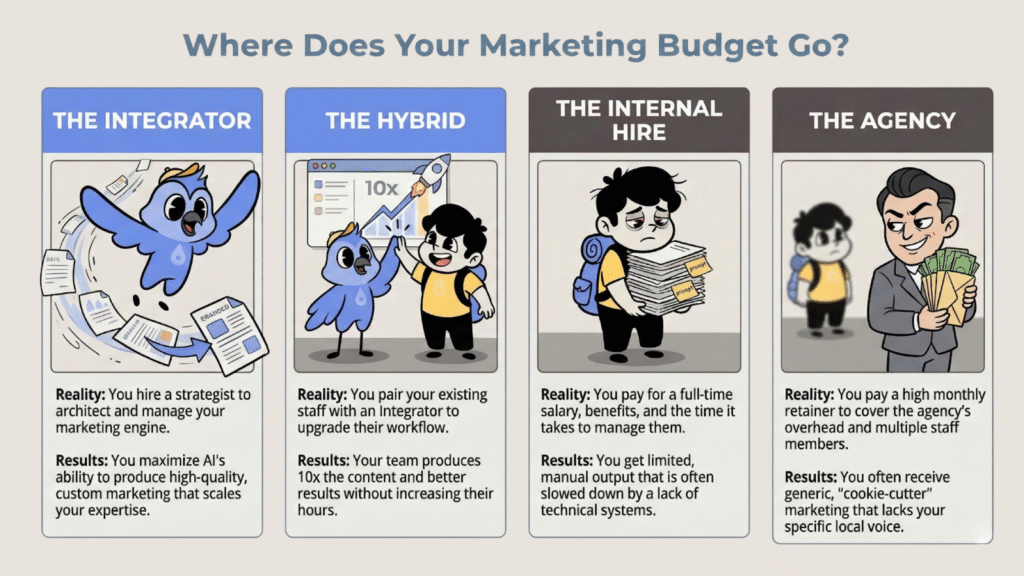
To find the right fit, you must consider your current revenue and growth goals. There are four common ways to staff your marketing. Each has different costs, speeds, and levels of owner involvement. In this chapter, we break down these four paths so you can choose the one that fits your business plan.
Path 1: The Marketing Integrator
The Marketing Integrator model is designed for the business owner who wants high-speed results without a high-priced headcount. This is often called the “Trailzi Way.” Instead of hiring a full-time employee or a traditional agency, you hire a specialist to build and manage your AI engine. On this path, the Integrator serves as your architect and operator.
We start by auditing your current tools to see where you are wasting money. Then, we train the AI on your specific brand voice and local area. Finally, we connect your systems—like lead intake, reviews, and content—so they run with minimal effort on your part. The main benefit of this path is capital efficiency. You are not paying for a $100,000 salary or a massive agency office. Instead, you are paying for a high-level strategist who uses AI to do the work of three people.
This model is ideal for owners who are too busy doing the work. You stay in control of the strategy, but you are no longer the one typing the prompts or scheduling the posts. You provide the expertise, and the Integrator provides the system. It is the leanest way to own your local market.
Path 2: The Hybrid Model
The Hybrid Model is for businesses that already have an internal staff member—like an office manager or a junior marketer—but feel they aren’t reaching their full potential. In this scenario, you don’t replace your person; you give them superpowers by pairing them with an Integrator. This path acknowledges that you have already invested in a human relationship you value.
In a Hybrid setup, the Integrator builds the Engine, and your staff member learns how to drive it. We set up the automations, the brand training, and the workflows. Then we train your employee to manage the system daily. This removes the production bottleneck that stops most internal employees from being effective. For example, your office manager might spend 4 hours a week writing a newsletter.
With the Hybrid model, the Integrator builds a system that the same manager can produce in 15 minutes.
The benefit here is internal culture. You keep the person who knows your customers by name, but you remove the manual labor that keeps them from growing the business. It turns a generalist into a high-output marketing asset.
Path 3: The Internal Generalist
The Internal Generalist is the traditional hiring a marketing person path. This person sits in your office, goes to your meetings, and handles everything from social media to event planning. For many years, this was considered the gold standard for local businesses because of the physical proximity to the work.
There’s real value in having someone on-site, someone who can talk to your team and capture what’s actually happening day to day. They’re there for the small moments you can’t really brief or outsource. However, the Internal Generalist often falls into “The Busy Trap.” Because they are generalists, they usually lack the technical systems-building skills required in 2026. They spend most of their day on manual tasks—writing one post at a time or updating the website manually.
From a budget perspective, this is often the most expensive path. When you add up salary, taxes, benefits, and office space, a mid-level marketer can cost $80,000 to $100,000 per year. If that person is doing manual work that an AI system could do in seconds, your cost-per-result becomes very high.
Path 4: The Traditional Agency
The Traditional Agency path involves outsourcing your marketing to a firm that manages multiple clients. You pay a monthly retainer, and they provide a team of specialists to handle your account. The promise here is professionalism and a hands-off experience for the owner.
The reality in 2026 is that many traditional agencies have an efficiency gap. Most agencies still bill based on manual hours. Even if they are using AI internally to speed up their work, they often haven’t lowered their fees for you. A big part of what you’re paying for often has nothing to do with your results. A chunk of it is channeled to support the agency’s own operations.
Another issue is that agencies often struggle with context. When you’re one of dozens of clients, it’s hard for any agency to really understand your market the way you do. You often end up with “polished” marketing that feels generic. This path is for the owner with a large budget who values the safety of a big firm over the maximum ROI of a lean system.
The Playbook: Local Dominance Strategies
This section outlines the specific blueprints an Integrator uses to build a local marketing engine. These strategies focus on turning your expertise into a permanent business asset that ranks your business and builds trust with local leads.
Strategy 1: Building Authority
In 2026, ranking in the “Map Pack” (the top three local results on Google) is determined by Local Relevance. To win, your business must prove to the algorithm that you are the most active and specific expert in your geographic radius. Most owners treat their Google Business Profile as a static listing. An Integrator treats it as a high-frequency proof-of-work.
The goal is to move from “Generic Information” to “Technical Dominance.” If a homeowner searches for a technical requirement in your specific town, and you are the only one with a detailed guide on that local code, you win the “Expert” label in the customer’s mind. The Integrator builds a system to extract this information from your daily work without requiring you to sit behind a keyboard.
We use a “Field Intelligence” workflow:
- The Field Capture: You snap a photo of a job site or record a 60 second voice memo explaining a specific challenge you solved that day.
- The Integrator Upload: You send these raw files directly to your Integrator. There is no need for you to format, edit, or write a single sentence.
- The Asset Deployment: The Integrator uses your raw Field Intelligence to create factual updates, localized FAQs for your website, and permanent guides that capture high-intent search traffic.
The Three Types of Permanent Business Assets
To rank your business at the top of search results, an Integrator helps you document three specific types of information. Each one proves to Google—and your neighbors—that you are the expert for your specific area.
- Field Activity Reports: These are brief, factual updates based on your recent job sites. They show Google you are active in a specific neighborhood right now, which helps you own that 2 mile radius.
- Technical Fact Sheets: These are the answers to the “Why” and “How much” questions you hear every day. When a lead reads a fact sheet about local codes or materials, they stop shopping for the lowest price and start looking for the person with the most local experience.
- Client Planning Guides: These are physical or digital documents—like checklists or reports—that solve a customer’s problem for free. This asset lives on your website forever, capturing leads while you are busy with other jobs.
Action Items: Building Your Expertise Library
You do not need to be a writer to build authority. You only need to report on the work you are already doing. Here is how you provide an Integrator with the information
they need:
- The 60 Second Memo: At the end of a job, record a quick voice note. Describe one thing that was unique about that house or that neighborhood. Mention the street name and the specific obstacle you overcame.
- The “Sent Folder” Audit: Find the three longest emails you’ve sent to customers explaining a technical process. Forward those to your Integrator. These are your most valuable “How-To” guides.
- The Top 5 Fears List: List the five things your customers ask about most (e.g., Permit delays, Hidden costs). Each of these guides will help you win more contracts.
Pro Tip: The Question-to-Guide Shortcut
Check your “Sent” folder for the last time you answered a customer’s technical question. That answer is a “Local Guide” waiting to happen. Post it as a GBP. Update or a short article today. Solving a problem for one person is the fastest way to prove your authority to thousand others.
How do I outrank national websites?
Small local businesses outrank national sites by providing hyper-specific local context, using neighborhood landmarks, and answering hyperlocal questions.
National sites provide general advice for a broad audience. They cover everything, everywhere. The problem is, your customer isn’t everywhere — they’re in one neighborhood, dealing with one specific issue. Google’s 2026 algorithm prioritizes Experience and Expertise. Meaning that what tends to win instead is the real, on-the-ground knowledge that only someone working in that area would know.
When you provide details that a national company cannot replicate, you become the most helpful resource for people in your zip code.
- Mentioning a local water tower or a specific school district signals your physical presence.
- Explaining how a recent local storm impacted specific neighborhood infrastructure builds immediate trust.
- Referencing local building codes ensures your neighbors know you are the qualified choice for the job.
Can AI actually write local content?
Yes, if you build local knowledge into the system using your own neighborhood names, service area facts, and project notes.
Generic AI doesn’t know your town, but it is an expert at general information. To get a high-quality result, you must provide the “Local Anchor” while letting the AI handle the “Base Content.” If you try to let the AI do both, the content will feel fake, and your neighbors will ignore it.
To do this yourself, you have to split the work:
- Your Job: Provide the Local Anchor. This is the 10% that only you know—the street name, the specific problem, or a local event.
- The AI’s Job: Provide the Base Content. This is the 90% that is universal—safety tips, technical explanations, or standard procedures.
- The Result: You spend 30 seconds giving the system a specific detail, and it spends 3 seconds writing the professional, helpful post around it.
Example in Action:
If a main pipe bursts in the Oak Creek neighborhood, a plumber can’t expect AI to know about it. However, the plumber can tell the AI: “Write a post for Oak Creek residents about the water main break. Remind them to boil their water for 24 hours once it’s back on.” The AI handles the base content—the standard safety advice about boiling water—while the plumber provides the local anchor that makes the post relevant to that specific street.
Strategy 2: The Reinvestment Engine
The most common mistake for a small local business is that they either delay marketing for too long or overspend before anything is working. Many owners believe they need a $5,000 monthly budget to see results. That way of thinking is outdated. An Integrator uses a Reinvestment Engine to start with a modest budget and scale only as the revenue arrives.
This strategy is built on the idea of a self-funding growth tool. Instead of trying to own the entire city on day one, we identify a specific high-margin service or neighborhood. We build a lean system to capture those leads, and then we use the profit from the first few jobs to fund the next level of the system.
The counseling office story follows this blueprint. He began as a solo counselor with a $500 monthly investment. We didn’t waste that budget on broad ads. We targeted a single high-need niche using Google Business Profile work. As his client list grew, he reinvested a percentage of his profit back into the Integrator’s system. Within two years, that $500 seed grew into a 4 person firm.
The Staircase Growth Model
The Reinvestment Engine works because it follows a predictable “Staircase” of investment. You only move to the next step when the current step is profitable. This protects your cash flow while ensuring your infrastructure keeps up with your lead volume. While there are many steps beyond these, this is a common example of how we scale a local firm:
- Step 1: Google Business Profile Foundation ($500 – $1,000/mo): The focus is 100% on Google Maps and local profile authority. The goal is to ensure you appear when local neighbors search for your primary service. You provide the Field Intelligence, and the Integrator ensures your profile is active and authoritative.
- Step 2: Local SEO & Deep Assets ($1,500 – $2,500/mo): Once your map presence is steady, we expand to local SEO by optimizing your website. We build deep authority assets—such as the checklists and guides mentioned in Strategy 1—to capture traffic from AI searches. At this phase, conversion is about getting people to download your resources so you can follow up via email.
- Step 3: Intent Tracking & Active Outreach ($3,000+/mo): We begin tracking visitors to your website. The system allows us to reach out to interested prospects via email and LinkedIn actively.
Once this system is built, many businesses choose to add traditional strategies, such as paid ads. Because the system is already in place to convert and follow up, ads become a way to increase volume and grow faster.
Once this system is built, many businesses choose to add traditional strategies, such as paid ads. Because the system is already in place to convert and follow up, ads become a way to increase volume and grow faster.
Protecting Your Time During Growth
As a small business grows, the owner’s time becomes the primary bottleneck. If you are successful, you become too busy to handle the marketing that made you successful in the first place. The Reinvestment Engine solves this by automating the low-value tasks first.
An Integrator ensures that as your client volume grows, your workload does not. We build systems to:
- Filter Leads: Using simple automated questionnaires to help screen out poor-fit inquiries so you’re only talking to serious prospects.
- Automate Follow-up: Once someone downloads a guide, they receive a professional series of emails without you lifting a finger.
- Reputation Scaling: Setting up triggers so every new client is prompted to leave a review, building your authority automatically.
Pro Tip: The 20% Reinvestment Rule Commit to reinvesting 20% of every new contract back into your marketing system. If you land a $5,000 project, put $1,000 toward building a new permanent asset or a new automation. This ensures your business grows through compound interest rather than luck.
How do I know when to increase my investment in AI marketing?
Increase your investment only when the current lead generation is stable, and you have hit a ceiling that requires more automation to overcome.
Small businesses often waste capital by buying complex software before they have a basic foundation of local visibility. A professional growth strategy focuses on funding the next stage of your system with the profits from the previous stage. The goal is to keep your marketing budget tied to your revenue. Instead, it becomes a fixed overhead cost that drains your cash flow during slow months.
As your business grows, you will notice specific triggers that indicate it is time to expand your system:
- If you’re ranking consistently in local search but leads aren’t increasing, your bottleneck is conversion. You need to move beyond basic profile work.
- If you’re getting more inquiries or traffic than you can properly track and follow up with, it usually means that it’s time to implement tracking and automation.
- Suppose you notice that your pipeline is steady and your follow-up runs without delays. This is a signal that your system is ready. That’s when you scale outreach and paid acquisition.
Strategy 3: Niche Precision
In a crowded local market, being a generalist is a financial liability. When you try to market to everyone in your zip code, your message becomes diluted, and you end up competing solely on price. An Integrator uses Niche Precision to identify the one specific, high-margin problem you solve better than anyone else. We then build an authority engine around that specific solution.
This strategy is about narrowing your focus to expand your profit. Instead of being the plumber, you become the specialist in tankless water heater conversions for historic homes. By narrowing the lens, your marketing becomes significantly more relevant to the highest-paying customers. When a customer is facing a high-stakes problem, they don’t look for the all-in-one guy; they look for the expert who has already answered their specific questions.
We use this blueprint to break through saturated markets where brand awareness is too expensive to buy. By dominating a small, specific niche, you can outperform competitors who have ten times your budget, simply because you are more relevant.
The Trust Stack Workflow
In high-stakes or sensitive industries, the sale doesn’t happen on the first click. It happens through a series of small moments where you prove your expertise. An Integrator builds a Trust Stack—a sequence of information that moves a lead from stranger to client by addressing their specific concerns before they even call you.
- The Specific Problem: We identify the most difficult, high-intent questions your best customers are asking.
- The Proof of Work: We use your Field Intelligence to show your process. Instead of saying you’re an expert, the focus is on documenting what you actually do.
- The Automated Bridge: We make sure that when a customer lands on your solution, the system automatically invites them to take the next step, such as downloading a specialized guide or booking a consultation.
Dominating AI Search with Specificity
As more customers use AI search tools (like ChatGPT or Google Gemini) to find local services, the Broad Generalist will disappear. AI tools prioritize the most relevant and detailed answer. If your website is the only one in your town with a detailed breakdown of a specific, complex local regulation or a niche technical fix, the AI will recommend you as the primary authority.
An Integrator ensures your business is the one the AI recommends by:
- Defining the Niche: Identifying the sub-services that your competitors are too broad to document.
- Building Fact Databases: Creating deep, factual pages about your niche that AI models can easily read and recommend to users.
- Local Nuance: Including the street-level details that prove you aren’t a national franchise, but the local specialist.
Pro Tip: The “Negative Niche” Filter
Decide today who you are not for. If you try to be the cheapest and the best, you will be neither. By explicitly stating who you serve (e.g., “We only work on homes built before 1970”), you make yourself the only viable option for that group, allowing you to charge professional rates.
Why is my marketing failing to attract high-quality leads?
High-quality leads ignore general marketing; they only respond to specific solutions that address their unique problems and prove your local expertise.
When your marketing is too broad, you attract price shoppers who do not value your specific expertise. An Integrator helps you shift your messaging from what you do to who you help specifically. This narrows your audience but increases your conversion rate because the prospects who find you are a perfect fit for your high-margin services.
Focusing on a specific niche builds deeper authority in less time:
- AI search engines recommend specialists over generalists when users ask complex, specific questions.
- Your Field Intelligence becomes more valuable because it addresses a recurring, difficult problem.
- You spend less on ads because you are only targeting the specific group of people who need your exact solution.
Strategy 4: The Referral & Reputation Engine
The most valuable lead in a local market is a referral, but most businesses leave them to chance. You do a great job, hope the customer tells a friend, and wait for the phone to ring. An Integrator uses a Reputation Engine to turn luck-based word-of-mouth into a predictable system. We move from hoping for a mention to providing the tools that make referring your business effortless.
This strategy focuses on three specific channels: digital reputation (Reviews), direct advocacy (Word of Mouth), and community influence (Local Online Groups). By systemizing these, you ensure that when a neighbor asks for a recommendation, your name isn’t just mentioned—a mountain of digital proof backs it.
The Plumbing Company followed this blueprint to dominate its local market. We didn’t just ask for favors; we provided high-tech touchpoints for their service technicians and a structured incentive program that turned their happiest customers into active advocates.
The Frictionless Review System
A review is only useful if it contains the right information. Most customers write “Great job!” which does nothing for your search rankings. An Integrator sets up a system to capture Keyword-Rich Reviews that tell Google exactly what you do and where you do it.
- NFC Review Cards: We provided the plumbing technicians with Tap-to-Review cards. At the moment, the job is finished, and the customer is happy. They can tap their phone to the card and be taken directly to the Google review page.
- Custom Review Links: We generate smart links that include Review Prompts. Instead of a blank box, the client sees a nudge: “Tell us about your [Service Name] in [City Name].”
- The Keyword Strategy: By encouraging clients to mention specific services (like “water heater repair” or “emergency leak”), your reviews act as SEO fuel, pushing you higher in local search results for those high-margin jobs.
Referral Partnerships & Area Validation
In many service industries, a formal Referral Partner Program turns your best clients into a motivated sales force. This is a professional agreement that rewards the client for their loyalty and advocacy.
- The Incentive Structure: An Integrator sets up the tracking for referral credits, service discounts, or free products. This gives the customer a reason to mention you when a neighbor asks for a pro.
- Community Sharing: We provide Shareable Assets—short, professional summaries of your work—that clients can easily drop into local Facebook or Nextdoor groups.
- Service Area Proof: We use your data to show the general regions where you are active. This “Area Validation” proves you are a local fixture without violating anyone’s specific street-level privacy.
Pro Tip: The Review Prompt Script
When asking for a review, say this: “It would really help us if you mentioned the specific type of repair we did today.” Most customers want to be helpful but don’t know what to write. Giving them a small nudge results in a much higher quality review for your local rankings.
Why are online reviews more important than ever?
Reviews are the primary data source for AI search engines; they use the keywords inside your reviews to decide if you are the most qualified local expert for a search.
In 2026, Google doesn’t just look at your star rating. It reads the text of the reviews to see if people are actually mentioning the services you claim to provide. If you have 50 reviews but none of them mention “emergency repairs,” you won’t rank for that term. A Marketing Integrator ensures your review system is designed to feed the algorithm the specific keywords it needs to rank you #1 in your area.
Systematizing your reputation provides three key advantages:
- NFC and custom links increase your review volume by reducing friction for customers.
- Referral partnerships offer a predictable customer acquisition cost that is lower than that of paid ads.
- Area validation proves your local dominance without violating client privacy.
Case Study 1: The Flood Zone Builder

The Story: The subject of this case study is a custom home builder specializing in elevated homes for flood-prone areas. In these regions, homeowners face a confusing maze of local codes, specialized insurance laws, and technical building requirements. Before working with an Integrator, this builder was fighting for visibility in a market where homeowners were overwhelmed by conflicting information. By implementing a Utility-Based Authority strategy, he became the definitive expert for his entire region.
The Problem: Fragmented Information
In coastal and flood-prone markets, homeowners usually have to piece together information from government websites, insurance agents, and general contractors.
- The builder wanted to win his local area but lacked a dominant digital presence.
- Prospective clients were confused by local flood coverage laws that differed from national standards.
- He needed a way to differentiate his specialized skills from those of a standard general contractor.
The Solution: The “Expertise Engine”
The Integrator conducted extensive keyword research, revealing exactly what local homeowners were struggling to understand. We then built a comprehensive Pillar Page and an ecosystem of resources that turned his company into the local source of truth.
The Integrator Workflow:
- GMB Optimization: We used our local research to optimize his Google Business Profile, ensuring he appeared for the most competitive “near me” searches.
- The Master Pillar Page: We built a definitive guide covering local codes, specific flood coverage laws, and a checklist of questions to ask a flood-zone contractor.
- Educational Assets: We created practical stuff homeowners actually needed: blogs, landing pages, ebooks, and downloadable checklists explaining how to reconstruct existing homes for flood compliance.
- Local Authority: We created a distribution structure—emails and social content—so that no matter where a local homeowner looked, this builder was the authoritative leader.
The Results: 1,000% Traffic Growth
By providing the resources that homeowners previously had to hunt for, the builder became the only logical choice. He stopped being a contractor and became a consultant whom people trusted with their most valuable asset.
| Metric | Before Integrator | Result |
| Website Traffic | Baseline | Nearly 1,000% Increase |
| SEO Keyword Count | Limited | Massive Expansion across Niche Terms |
| Local Search Rank | Page 1-3 | #1 for Most Competitive “Near Me” Keyword |
The Authority Takeaway
The Lesson: The Google Business strategies in this book aren’t just for plumbers or roofers. Some of our best results come from specialized fields like medical labs, doctors’ offices, and high-end builders. The principle remains the same: If you are the first person to provide a practical, unified answer to a homeowner’s complex problem, you win the market.
The 30-Second Takeaway: Stop trying to sell and start being useful. In high-stakes industries, your potential customers are usually overwhelmed by fragmented information. If you create the single, definitive resource that solves their confusion (like a local building code guide), you stop being a contractor and become the only trusted authority. High-value leads don’t want a sales pitch; they want a professional who has already done the homework for them.
Case Study 2: The Counselor (The Reinvestment Engine)

The Story: A solo practitioner in the North had a vision for a higher standard of care in her community. She wasn’t impressed with the existing options and wanted to build something herself rather than working for a large agency. Her hurdle? She had a start-up budget of only $500 a month. By sticking to a strategic reinvestment plan and attacking market gaps, she grew from a solo office into a thriving 4 person practice in a new professional building.
The Problem: Visibility on a Shoestring Budget
The counselor knew the fundamental truth: if people don’t know you exist, you can’t help them. However, with only $500 a month, she couldn’t afford to waste money on broad brand awareness or expensive lead-buying services.
- The Budget Constraint: $500 had to cover everything.
- The Market Saturation: General counseling terms were crowded.
- The Vision: She needed a system that would not only fill her own schedule but eventually fund the hiring of additional specialists.
The Solution: The “Gap-Fill” Strategy
The Integrator didn’t guess. We performed a fully human research project to find the missing expertise in her specific town. We looked for the areas where the big agencies weren’t meeting local needs.
The Integrator Workflow:
- The Gap Analysis: Our research revealed that while there were many generalists, there were massive voids in specialized care—specifically teen issues, high-conflict divorces, and addiction.
- Strategic Targeting: We didn’t market her as “just a counselor.” We boldly pointed her marketing toward those specific high-need skills.
- The GBP Precision Strike: Because the budget was small, we focused 100% of the effort on the Google Business Profile (GBP). We optimized every inch of it to build trust with Google’s algorithm for those specific gap keywords.
- The Hiring Roadmap: As she filled her own slots, she didn’t just hire “any” counselor. She used our gap analysis to hire providers who specialized in the remaining local needs, ensuring every new hire had a pre-warmed market waiting for them.
The Results: 4x Growth & A New HQ
By dominating the local map for high-intent keywords, the phone started ringing immediately. She booked every available time slot.
| Metric | The $500 Start | 24 Months Later |
| Provider Count | 1 (Solo) | 4 (Specialized Team) |
| Market Rank | Unranked | #1 for nearly every target keyword |
| Client List | Empty | 100% Capacity (Waiting List) |
| Office Space | Small Starter Office | New Professional Building |
The “Reinvestment” Takeaway
The Lesson: In 2026, $500 is enough to win if you aren’t trying to be everything to everyone. By identifying the specific gaps in your local market and winning those keywords first, you create the cash flow to hire specialists who fill the other gaps. This is how you build a firm, not just a job.
The 30-Second Takeaway: Don’t spend money on broad marketing until you know where the gaps are in your city. Using a human-led keyword audit will help you find the keywords your competitors are not targeting. Win those specific terms on Google Maps first, then use that revenue to scale into a multi-provider firm.
Case Study 3: The Private Home Care Owner

The Story: A private home care owner came to us after firing agency after agency. His frustration was specific: he wanted high-value, private-pay clients, but every lead he got was looking for insurance-covered services. He had a strictly fixed budget, refused to reinvest profits into more aggressive growth, and was unwilling to change his intake process. He gave us a very small square inch of ground to work with—and we had to make it profitable.
The Problem: The Generic Keyword Trap
The owner had been bidding on broad terms like “Home Care.” In the world of local search, “Home Care” is a broad category that encompasses everything from state-funded aid to medical home health.
- The Lead Mismatch: By targeting general terms, he was drowning in low-quality calls from people who couldn’t afford his private-pay rates.
- The Budget Ceiling: Like the Counselor, he had a fixed monthly spend and zero interest in scaling his investment, regardless of the results.
- Process Rigidity: He didn’t want AI bots or outsourced qualifiers; he wanted the phone to ring only with perfect prospects.
The Solution: Market Surgery
Since we couldn’t change the owner’s budget or his process, we had to change the Targeting. We used AI-assisted research to find the “Efficiency Gaps”—the specific phrases high-intent, private-pay families use that the big-budget insurance agencies were ignoring.
The Integrator Workflow:
- Keyword Extraction: We moved away from “High Volume/Low Quality” terms (Home Care) to “Low Volume/High Intent” terms (Private Duty Home Care, Luxury Senior Care).
- GBP Feature Maxing: Since the budget was locked, we squeezed every drop of value from the Google Business Profile (GBP).
- Creative Offers for Clarity: We used the Offers feature on Google not just for discounts, but for Pre-Qualification. We created offers like “Private-Pay Consultation” to signal immediately that this was not a state-funded agency.
- The Booking Filter: We implemented the Bookings feature as a soft gatekeeper. By the time a lead clicked “Book,” they had already seen the specific language defining his private-pay model.
The Results: The “Clean” Lead Flow
By narrowing the lens, we didn’t just get him more calls—we got him the right calls. He achieved #1 rankings for the niche keywords that actually paid his bills.
| Metric | Before Integrator | Result (Fixed Budget) |
| Lead Type | 90% Insurance/State-Aid | High % Private-Pay Intent |
| Search Rank | Buried under Franchises | #1 for Niche Private Keywords |
| Budget Increase | N/A | $0 (Stayed at base spend) |
The Precision Takeaway
The Lesson: If you have a limited budget and a rigid process, you cannot afford to be a generalist. You must perform Market Surgery to find the specific keywords your competitors are overlooking. By using standard tools like GBP Offers and Bookings creatively, you can filter out the noise and protect your time.
The 30-Second Takeaway: Most business owners waste money competing for the biggest keywords. An Integrator finds the cleanest keywords. If your budget is fixed, stop trying to win the Home Care war and start winning the Private Duty battle. Use Google’s built-in tools (Offers/Bookings) to tell people who you are NOT for before they ever pick up the phone.
Case Study 4: High-Volume Home Care

Operating in a massive metro area, this agency had a clear mission: high-volume growth. They primarily served Medicaid clients and needed a steady stream of leads to sustain their growth. By moving past generic companion care and addressing the psychological barriers faced by family members, we turned a digital presence into a Referral Machine that even hospital discharge planners couldn’t ignore.
The Problem: The Invisible Care Gap
In a large metro market, the adult child (the “Sandwich Generation”) is usually the decision-maker and is drowning in guilt and burnout.
- The Shame Barrier: Families felt they were giving up by hiring help.
- The Visibility Gap: Once a caregiver is in the home, the family often feels disconnected from what is actually happening day to day.
- The Relationship Ceiling: Most referrals required an owner to visit hospitals with brochures, which doesn’t scale personally.
The Solution: The Family Success Framework
The Integrator didn’t just increase ad spend; we redefined the Value Proposition. We shifted the focus from watching your parents to restoring your family. We attacked the emotional barriers and built physical “Loyalty Assets.”
The Integrator Workflow:
- Redefining Care: We marketed the idea that by letting an agent handle the basics (cleaning/cooking), the family could focus on Quality Memories.
- The Family Time Guides: We created physical guides for our staff to leave in the seniors’ homes. These weren’t ads; they were intentional resources designed to help the adult children have meaningful interactions with their parents during their visits.
- The Daily Report System: We implemented a Day-in-Review report. When the daughter walked into her mother’s house after work, she saw a professional document detailing the day’s activities, mood, and care.
- Targeted Practicality: We optimized for high-intent keywords like post-operative recovery, respite care, and caregiver burnout—the exact moments when families are most desperate for a Match Plan they can trust.
The Results: Institutional Trust
By blowing up the digital world and backing it up with high-touch physical assets, we created Institutional Trust. Hospital discharge representatives began calling us because our system made them look professional and prepared.
| Metric | Before Integrator | Result (High Volume) |
| Referral Source | Manual/Owner-Driven | Systematic/Hospital-Inbound |
| Customer Loyalty | Transactional | High-Touch Family Partner Status |
| Market Status | One of many | Recognized Metro Authority |
The Referral Machine Takeaway
The Lesson: In a high-volume market, you win by being the most practical and the most visible. When you solve the shame of the adult child and provide them with Daily Reports and Family Time Guides, you aren’t just a service—you are a relief valve. This level of intentionality is what triggers professional referrals from hospitals; they want to send patients to the agency that has a documented system for success.
The 30-Second Takeaway: Your marketing shouldn’t end when the contract is signed. Use Loyalty Assets like Daily Care Reports and Family Time Guides to prove your value every single day. When the family sees your intentionality, they become your biggest referral source. This is how you move from chasing leads to receiving institutional referrals from doctors and hospitals who trust your system.
Case Study 5: The Local Plumber

A highly experienced plumber decided to strike out on his own at the same time as a colleague. Both had identical technical skills, but their paths diverged immediately. While the colleague focused on his digital reputation, our client focused solely on doing the work and hoping for referrals. Two years later, the better plumber was struggling to find leads, while his buddy was dominating the local market. By implementing a Reputation Engine powered by automation, we helped him not only catch up but overtake his competition.
The Problem: The Invisible Expert
Our client was technically superior, but in 2026, the market doesn’t reward the best technician; it rewards the most visible one.
- The Reputation Gap: His buddy had hundreds of reviews and a Live Google Profile; our client had almost zero digital footprint.
- The Time Trap: He knew he needed to post photos and get reviews, but he was too busy working to manage his marketing.
- The Referral Ceiling: Relying on organic word of mouth was too slow to support a growing business.
The Solution: The Hyper-Local Automation
We didn’t ask him to become a marketer. We built a system that automatically captured his Field Intelligence. We focused on owning his backyard first, ensuring he was the #1 choice within a 5 mile radius before expanding.
The Integrator Workflow:
- Hyper-Local Wins: We performed research to identify the high-volume plumbing needs in his immediate neighborhood. We optimized his Google Business Profile to rank first for “near me” searches in his specific zip code.
- Reputation Automation: We removed the friction of asking for reviews. We gave him NFC Scanners (tap-to-review cards). When the job was done, the client just tapped their phone to the card, and the review link appeared instantly.
- The “Snap-and-Share” Pipeline: We gave him specialized upload links. Instead of logging into complex apps, he could snap a photo of a completed install and text it to a private link that automatically updated his Google Profile with the correct location data.
- Account Management Automation: We automated the “Ask.” If a review wasn’t left at the door, the system sent a personalized, timed follow-up that made it effortless for the customer to vouch for him.
The Results: Overtaking the Competition
By automating the boring parts of marketing, he finally showed the world he was the better plumber. Today, his lead flow is consistent, and he is no longer playing catch-up to his friend.
| Metric | Before Automation | After Automation |
| Google Review Velocity | < 1 per month | 5-10+ per week |
| Google Map Ranking | Unranked (Page 3+) | Top 3 (The Map Pack) |
| Lead Source | Hope & Referrals | Predictable Digital Inbound |
The Reputation Takeaway
The Lesson: Being the best at your trade is only half the battle. If you don’t have a system to capture your success, you are invisible to the modern customer. Automation isn’t just about saving time; it’s about ensuring that every job you do works for you forever by building your digital authority.
The 30-Second Takeaway: If you are too busy to do marketing, you are the perfect candidate for automation. Use NFC Scanners and automated review links to capture the moment of high satisfaction at the doorstep. Don’t try to be a better marketer; just build a better system to capture the great work you are already doing.
The Financial Audit

In my experience, marketing is often the most misunderstood line item on a professional P&L. Many owners continue to pay for services out of a sense of obligation or fear, rather than a clear understanding of the return. This section is designed to help you perform a system audit to identify where your current spend is being wasted on manual tasks that should be automated.
The Marketing Budget Worksheet: Identifying Your Efficiency Gap
An Efficiency Gap occurs when a business pays professional-level fees for entry-level administrative tasks. Use this checklist to audit your marketing invoices over the last 90 days.
The Efficiency Gap Checklist
Check any of the following that apply to your current marketing operations:
▢ Static Assets: You are paying a monthly retainer, but your website content, project galleries, and Practical Stuff resources haven’t been updated in over 60 days.
▢ Manual Reputation Management: Your office staff manually texts or emails clients for reviews. (A NFC Tap-to-Review system handles this at the point of service for a one-time hardware cost).
▢ Unfiltered Lead Costs: You are paying a flat fee for leads that haven’t been qualified by an automated system, forcing you to spend hours on the phone with non-prospects.
▢ Generic Content Production: You are paying for social media management that consists of stock photos and holiday greetings rather than localized expertise-driven content.
▢ Administrative Bottlenecks: Your marketing partner requires you to spend hours every week explaining your business to them because they don’t have a system to capture your Field Intelligence automatically.
Case Study Annex: Transferable Lessons
Don’t just read these stories as success stories; read them as Benchmarks. If you are interviewing a marketing partner or evaluating your internal team, use these specific results to set the standard for what you expect.
Case 1: The Flood Zone Builder (Authority)
- The Lesson: Expertise is your most valuable currency.
- Ask yourself: “Does my website solve a complex local problem, or is it just a digital brochure?”
Case 2: The Local Counselor (Niche Gaps)
- The Lesson: You don’t need a massive budget to win if you target the gaps.
- Ask yourself: “Have we identified the specific services my competitors are not targeting?”
Case 3: Private Home Care (Lead Filtering)
- The Lesson: More traffic is a liability if it’s the wrong traffic.
- Ask yourself: “Are we using Offers and Booking tools to tell people who we are not for?”
Case 4: Metro Home Care (Referral Loops)
- The Lesson: Institutional trust is built through physical and digital consistency.
- Ask yourself: “Do we provide guides or reports that make it easy for professional partners to refer us?”
Case 5: The Local Plumber (Reputation Automation)
- The Lesson: Automation is the only way to build a reputation while staying busy in the field.
- Ask yourself: “Can my technicians capture a 5 star review in 3 seconds without typing a single word?”
A true Marketing Integrator looks at your business as a series of interconnected systems. If your current partner cannot explain how they are automating your reputation or filtering your leads to save you time, they are likely operating in the old world of marketing.
Choosing Your Execution Model

By now, the reality should be clear: The old world of marketing is too slow and too expensive, but AI-only marketing is too generic to build real trust. The winner in 2026 is the business owner who uses an Integrator to bridge that gap.
But how do you actually pull the trigger? Depending on your stage of growth and your budget, you have three distinct paths.
1. The Internal Path (DIY / In-House)
Best for: The start-up or solo practitioner with more time than capital (The “$500 Counselor” model).
- The Strategy: You become the Integrator. You use the tools we’ve discussed—GBP optimization, basic AI drafting, and automated review cards—to build your own foundation.
- The Risk: The Owner Bottleneck. Eventually, your time becomes too valuable to spend managing systems.
- The Goal: Build enough initial traction to fund a move to the Hybrid or Professional path.
2. The Hybrid Path (Staff + Tools)
Best for: Established offices with a marketing coordinator or admin.
- The Strategy: You keep your staff, but you equip them with the Integrator’s Toolkit. Instead of them manually posting to social, you train them to use AI to scale your field intelligence into blogs, emails, and landing pages.
- The Risk: Without a high-level strategist (an Integrator), your staff might produce more noise instead of better results.
- The Goal: Increase output by 5x without increasing your internal payroll.
3. The Professional Path (The Trailzi Model)
Best for: The business ready to dominate their metro area and buy back their time.
- The Strategy: You hire a Marketing Integrator to own the system. We do the heavy lifting—the research, AI negotiation, fine-tuning, and automation setup.
- The Result: You get the output of a $10,000-a-month agency for a fraction of the cost.
- The Goal: Total market authority and a predictable referral machine.
Final Thoughts: The Cost of Waiting

In every case study we’ve looked at—the plumber, the counselor, the flood-zone builder—there was a turning point. It was the moment they stopped trying to work harder at marketing and started working smarter with a system.
The “Invisible Tax” of $8,000 a month isn’t just about the money you spend; it’s about the opportunities you lose while your competitor is winning the Map Pack. You don’t need a massive budget to start, but you do need to start.
Your Next Step
Audit your business today. Look at your Efficiency Gap. Are you paying for manual labor, or are you investing in a system?
At Trailzi, we don’t just do marketing. We build the engine that makes your expertise visible to the people who need it most. Whether you have a $500 start-up budget or are looking to scale a multi-million dollar metro agency, the math remains the same.
Stop being the best-kept secret in your city. Let’s build your Authority Engine.
Your 90-Day Authority Roadmap
You didn’t read this book just to learn about marketing theory; you read it to change the trajectory of your business. Use this checklist to transition from the old world of manual labor to the new world of Integrated Authority.
Phase 1: The Foundation (Days 1–30)
▢ The “Near Me” Audit: Perform a search for your top 3 services. If you aren’t in the Map Pack, identify the #1 competitor and look at their review count. That is your first target.
▢ Reputation Automation: Stop manually asking for reviews. Order your NFC
Tap-to-Review cards or set up an automated text follow-up system.
▢ Claim Your Gaps: Identify one niche service (like “Teen Counseling” or “Post-Op Home Care”) that your competitors are ignoring. Update your Google Business Profile to highlight this expertise.
Phase 2: The Authority Build (Days 31–60)
▢ The Pillar Asset: Create one piece of Practical Stuff. Whether it’s a Flood Zone Code Guide or an IT Security Checklist, build the resource that makes you the consultant, not just the contractor.
▢ The Content Bridge: Use AI to turn that one Pillar Asset into 5 blog posts and a 3 part email sequence. Remember: Generate, Negotiate, and Fine-Tune.
▢ Lead Filtering: Add a Qualifier to your website. Instead of a generic contact form, ask a specific question that identifies high-intent clients (e.g., “Are you looking for Private-Pay or Insurance-Based care?”).
Phase 3: The Scaling Phase (Days 61–90)
▢ The Efficiency Audit: Look at your marketing spend. Identify one task you are currently paying a human to do manually and replace it with a system.
▢ Institutional Referrals: Take your Practical Stuff guide to one local professional partner (a doctor, a realtor, a lawyer) and show them how it helps their clients.
▢ Reinvest: Take the 70% you saved by using an Integrator and put it back into targeted local ads to pour gasoline on the fire you’ve just built.
Ready to Close the Gap?
If you’re ready to stop being the Invisible Expert and start building a system that works as hard as you do, we’re here to help. At Trailzi, we specialize in helping local businesses bridge the gap between their expertise and their market.
Whenever you’re ready, here is how we can help:
- The Free Audit: Let’s look at your Efficiency Gap together and see exactly where you are overpaying.
- The Integrator Setup: We’ll build your Authority Engine, from GMB optimization to your specialized Pillar Pages.
- The Total Scale: We manage the entire system so you can focus on running your business.
Visit Trailzi.com to schedule your 30 minute Strategy Session.