
YouTube works best for small businesses as a content extension channel — repurpose Google Business Profile videos and short job clips, and post consistently to stay active.
YouTube can be useful for a small business, but not in the way most “YouTube marketing” advice suggests. Building a viral channel from scratch is rarely the right investment for a local business with a defined service area. Using YouTube as part of a connected marketing system, on the other hand, is one of the easiest content multipliers available.
YouTube Is a Continuity Channel, Not a Standalone Lead Engine
The most realistic way for a small business to use YouTube is as an extension of the content already being created for other channels. A short video posted to a Google Business Profile can be uploaded to YouTube the same day. A job site walkthrough, a product demo, or a behind-the-scenes clip filmed for social media can live on YouTube too. The work of creating the content is already spent. Posting it to a second channel doubles the surface area without doubling the effort.
This approach also means YouTube shows up in Google search results for branded queries — someone searching the business name often finds the YouTube channel alongside the website and Google Business Profile, which reinforces credibility without requiring a separate content strategy.
A Quiet Channel Hurts More Than No Channel at All
The biggest risk with YouTube for a small business is letting it sit dead. A prospect who finds a YouTube channel with the last video posted three years ago often assumes the business has closed. The same logic that applies to social media awareness applies here: even if YouTube is not driving leads directly, the channel has to look active for the businesses that visit it to feel confident reaching out.
That means a small business should either commit to posting consistently — even simple content, posted regularly — or skip YouTube entirely. There is no middle ground.
The Best Content for a Small Business YouTube Channel Is Local and Specific
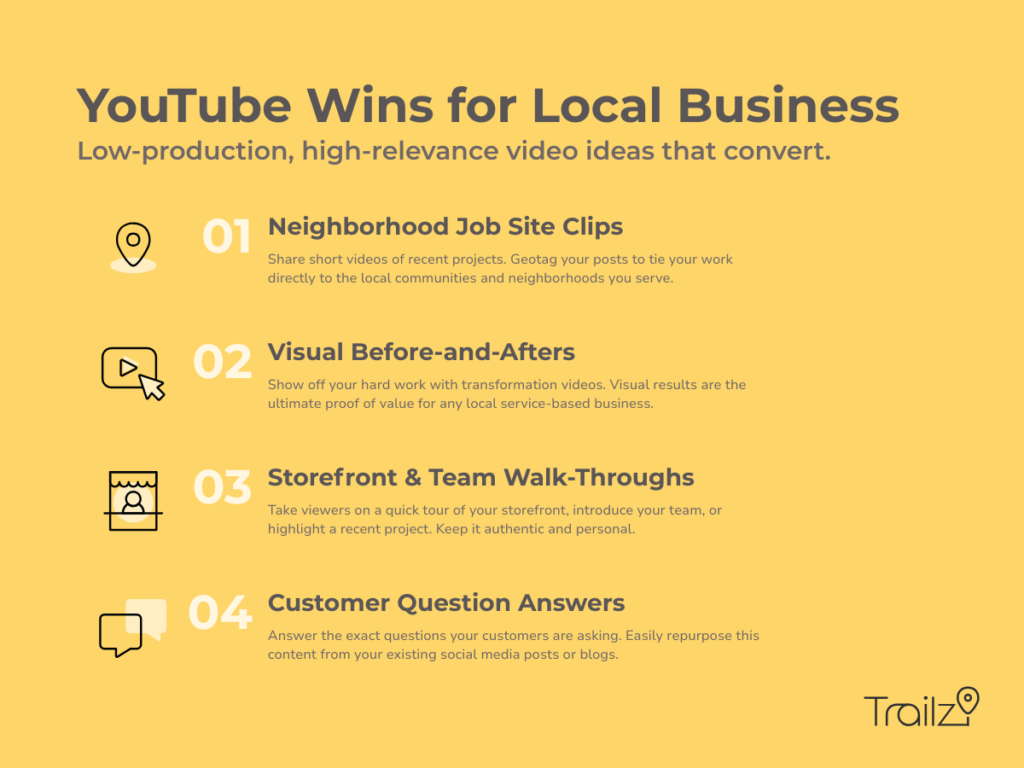
For local businesses, the content that performs best on YouTube tends to be the content that already serves other parts of the marketing system. A few formats that work well:
- Job site clips: short videos of recent projects, with geotagged context tying them to the neighborhoods served
- Before-and-afters: transformation videos for service businesses where the visual result is the proof
- Walk-throughs: quick tours of the storefront, the team, or a recent project
- Question answers: short videos answering the questions customers actually ask, repurposed from social posts or blog content
None of these needs to be highly produced. A phone-shot video with clear audio is enough. The point is consistency and local relevance, not production value.
YouTube Supports Local Search, It Doesn’t Replace It
For a small business focused on local growth, the work that drives Map Pack rankings — Google Business Profile optimization, customer reviews, hyper-local content, and citations from community involvement — does the heavy lifting. YouTube adds another surface where the business shows up when someone searches for it, and another place where existing content can earn views.