HVAC businesses win emergency calls by dominating Google Maps with strong location signals, fast response indicators, and 24/7 availability content.
When a homeowner’s AC dies in July or their heat goes out in January, they don’t research. They open Google Maps, type “HVAC near me,” and call one of the first three results. The HVAC company that shows up at the top of that map, with the right signals next to its name, wins the call before competitors even get a chance.
How does Google Maps decide which HVAC company shows up first?
Google Maps ranks local businesses based on three factors: proximity, relevance, and prominence. Proximity is fixed by where the searcher is standing. Relevance and prominence are where HVAC companies can actually compete.
These are the signals that push an HVAC business higher in Maps:
- A primary category set specifically to “HVAC contractor” or “Air conditioning contractor,” not a generic “contractor”
- Service areas covering every neighborhood, suburb, and zip code the business actually serves
- Operating hours marked as “Open 24 hours” if the business offers emergency service, with that detail also written into the business description
- Attributes turned on for “Emergency service,” “Onsite services,” and “Online estimates” when applicable
- Regular photo uploads of trucks, technicians, and completed installs
Most HVAC companies set up their Maps listing once and never touch it again. The ones that update weekly and keep their service areas current consistently outrank the set-it-and-forget-it competitors.
What makes a homeowner call one HVAC company over another in an emergency?
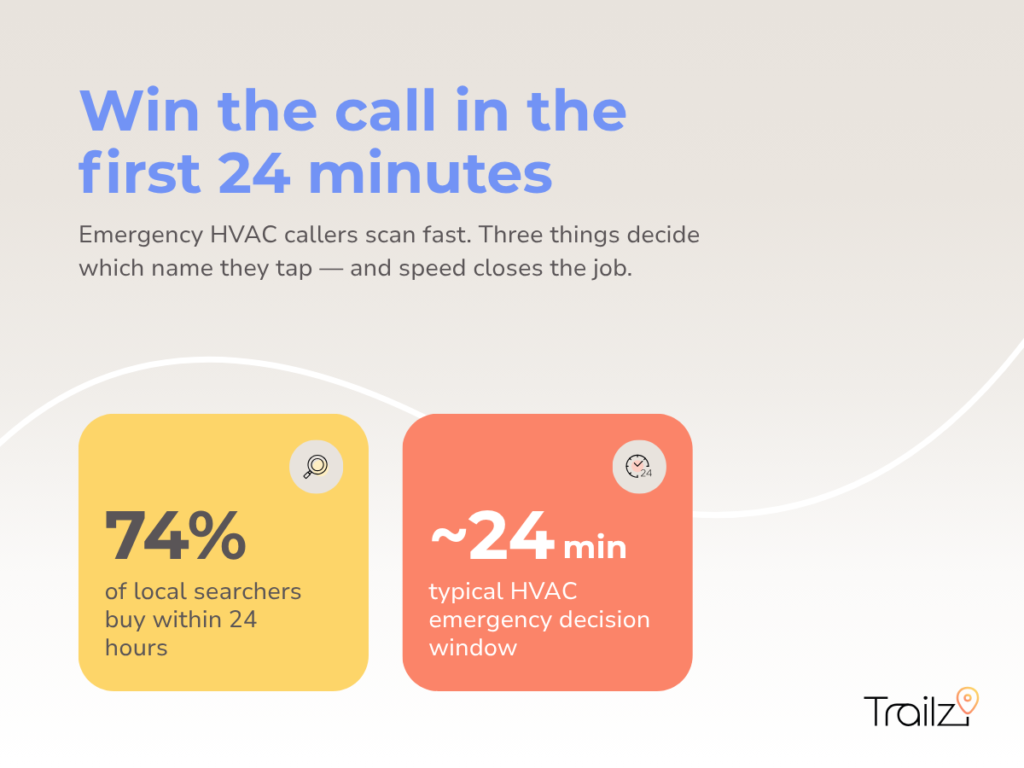
Emergency callers scan fast. They’re hot, frustrated, or worried about a frozen pipe. And these three things decide which name they tap:
- Star rating and review count are visible right on the Maps result
- Response time signals like “Usually responds in 15 minutes” or “Open now”
- A real phone number that connects to a human, not a voicemail tree
Around 74% of local searchers buy within 24 hours, but for HVAC emergencies, the window is usually 24 minutes. The company that picks up first almost always books the job.
How can an HVAC business use content to capture emergency searches?
Emergency-specific content gives Google extra context about when and how an HVAC business serves its market. Generic service pages don’t tell Google much. Pages built around urgency, location, and specific problems do.
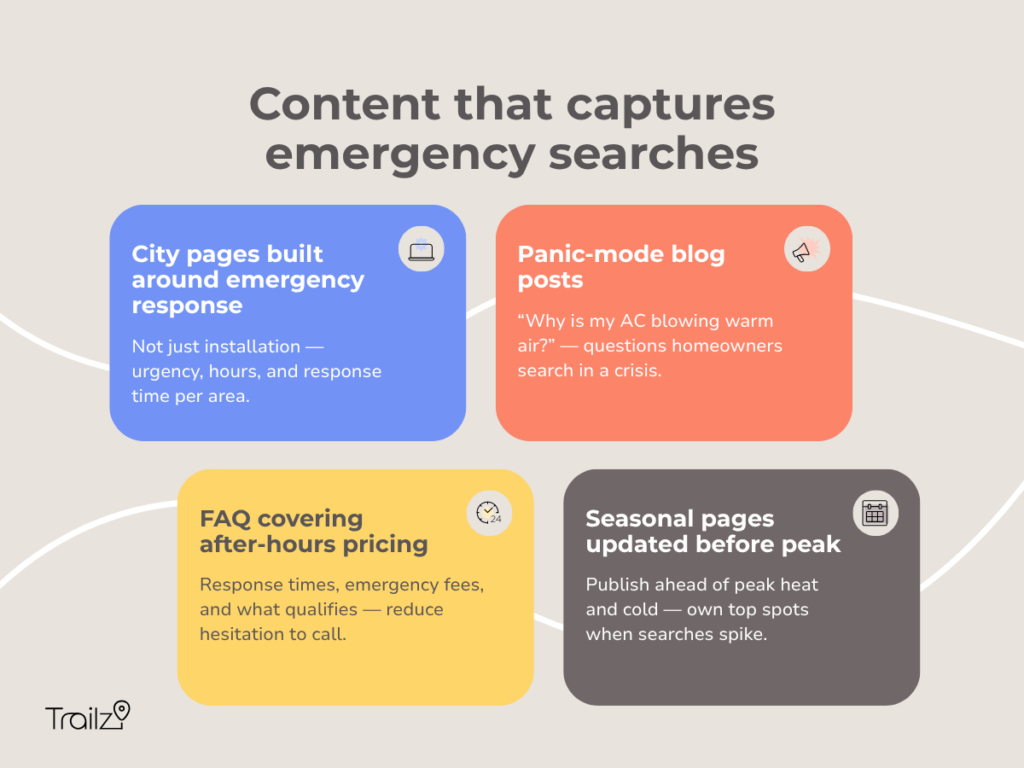
Content that helps capture emergency searches:
- Service pages for each city served, written around emergency response, not just installation
- Blog posts answering specific panic-mode questions homeowners actually search (“Why is my AC blowing warm air?” “Furnace won’t turn on in winter”)
- FAQ content covering response times, after-hours pricing, and what counts as a true emergency
- Seasonal pages updated before peak heat and peak cold hit
Search behavior shifts dramatically by season. An HVAC business that publishes content ahead of the rush owns the top spots when demand spikes.
Building trust before the emergency happens
A homeowner is far more likely to call the HVAC company they’ve already heard of. Sponsoring a local sports team, partnering with home inspectors and real estate agents, and showing up in community Facebook groups all build name recognition that pays off the moment someone needs an HVAC service.
HVAC marketing rewards visibility, speed, and trust. The companies that show up first on Maps, answer fastest, and stay familiar in the community are the ones homeowners call when something goes wrong.
When a homeowner’s system fails in extreme weather, they don’t have the luxury of time, which naturally brings business owners to the ultimate question: “How do I market my HVAC business for emergency calls?” The answer lies in a relentless focus on speed, visibility, and trust. By optimizing your Google Maps profile for 24/7 availability, creating urgent, location-specific content that answers panic-driven questions, and maintaining a strong local presence, you position your business to be the immediate solution. Ultimately, winning the high-stakes game of emergency dispatch comes down to dominating the local search results and being the first to answer the phone when a crisis hits.