
A marketing company understands Argyle when they have a system for local trends, automated ways to capture content, and consistent local output.
Every community has a local spirit only the people in it really understand. Argyle is no different. The town has a specific rhythm — the families moving in, the schools, the small businesses everyone knows, the events that get people talking. A marketing company that gets this can produce work that feels local. One that doesn’t tend to produce content that could apply anywhere.
The question is how a small business actually verifies which kind of agency they’re working with. These three signs tell the story.
A System for Sharing Local Trends With the Marketing Team
A marketing agency can’t react to what’s happening in Argyle if nobody tells them about it. The first thing to check is whether there’s a working channel for that information to flow.
The system doesn’t have to be complicated. A monthly business review where the owner shares what’s going on in the community is enough for many small businesses. A shared Slack channel where employees post relevant local news as it happens works too. What matters is that the information moves regularly, from the business to the agency.
This is important because timing is everything for local relevance. A roofer right after a storm has a small window where their marketing can land with maximum impact. A plumber dealing with a neighborhood water main issue can use that moment to remind residents about boil-water guidance. And that builds trust and visibility at the same time. Both of these depend on the marketing team knowing what’s happening, fast.
It also works for events that aren’t urgent. When a local high school graduates a class that includes the owner’s customers or their kids, a quick post acknowledging that on the Google Business Profile or social media can do well. But the agency has to know it’s happening to write it.
If the marketing company has never asked about local events, doesn’t have a system for receiving updates, and isn’t curious about what’s going on in town, that’s a real signal.
Automated Systems That Capture Local Content
The second sign is whether the marketing team has built automation into the process that consistently feeds local content into the strategy.
This matters because manual processes break down. A small business owner who’s running operations, managing employees, and serving customers doesn’t have time to upload photos every week or chase down testimonials for Google reviews. When local content depends on manual effort from a busy business owner, it usually disappears when things get hectic.
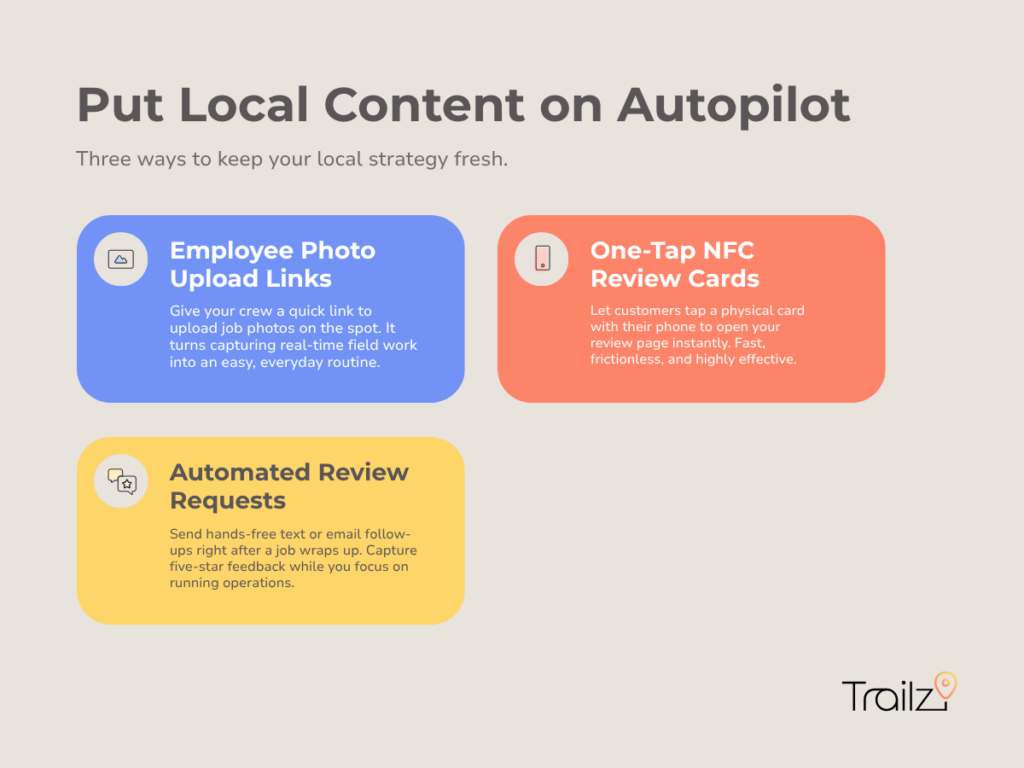
Marketing teams that understand small business reality build automation from the start. A few common examples:
- A photo upload URL for employees to use at the end of every job.
- NFC cards that take a customer directly to the review page with one tap.
- Automated text or email review requests that go out right after a job is complete.
Each of these turns local content into a routine. A marketing team that has built systems like these has thought about how to capture local content sustainably. One that hasn’t is going to struggle to produce the local feeling that moves customers in Argyle.
Content That Actually Reflects Local Life
The third sign is the easiest to spot. Look at the content the marketing agency has already produced.
Not all of it needs to be local. A business serves both local and broader audiences, and some content is built for the broader picture. But the content that does reference local life has to do two things: be accurate, and show up regularly.
Regularity matters because local content is a compounding signal. A single locally relevant post every few months looks like an afterthought. But a steady stream of local content, month after month, establishes the business as part of the community. Google reads it. Customers read it. The cumulative effect is what creates real local presence.
A quick review of the agency’s recent work — the Google Business Profile posts, the website blog, the social feeds — will show whether local content is sporadic or consistent, and whether what’s there feels like it was written by someone who actually knows Argyle.
What to Do With the Answers
A marketing company that passes all three tests has the systems, the process, and the output to actually represent a small business locally. One that fails on one or more of them is going to have trouble producing content that reflects how Argyle is changing, who lives here now, and what’s worth talking about this week.
For a small business in Argyle, the right marketing company isn’t necessarily the biggest one or the cheapest one. It’s the one that has the infrastructure to keep up with the community and the discipline to use it consistently.