
Attorneys build local search visibility through an optimized Google Business Profile, consistent client reviews, practice area pages, and legal directory citations.
Most people searching for legal help aren’t browsing — they’re in a situation, and they need someone fast. Searches like ‘DUI attorney near me,’ ‘family lawyer in [city],’ and ‘personal injury attorney [neighborhood]’ carry real urgency, and the firms that show up first get the call.
A Google Business Profile Needs to Reflect How Clients Actually Search
Most law firm profiles aren’t fully optimized. Google evaluates profiles on activity, completeness, and relevance. A dormant profile loses ground to competitors who are actively maintaining their local marketing presence.
A well-optimized attorney profile includes:
- Precise practice area categories, not just “lawyer.”
- A detailed description using terms that clients actually search for
- Regular Google posts tied to legal topics or firm news
- Geotagged photos of the office, team, and community involvement
- Consistent name, address, and phone number across every legal directory
The more specific the profile, the more confidently Google can match the firm to the right searches.
Review Velocity Wins Cases Before the Consultation
Potential clients read reviews the way they used to ask friends for referrals. Volume matters, but recency matters more. A firm with 90 reviews and three coming in monthly consistently outranks one with 300 reviews and nothing new in six months.
The firms that stay visible have a system. They ask every satisfied client at the right moment, make the process easy, and respond to every review. That steady flow of fresh proof tells Google the firm is active and worth recommending right now.

Practice Area Pages Turn the Website Into a Local Signal
A Google Business Profile gets a firm into the local Map Pack conversation, but your website’s localized practice area pages are what close the gap and build true organic authority. Google rewards geographic relevance. If a prospective client is looking for a car accident lawyer in your city, a generic page about your practice will almost always lose to a highly targeted, locally optimized page.
To transform your practice area pages into powerful local SEO signals, you need to move away from boilerplate text and implement a localized marketing strategy:
- Build a Clear Geo-Hierarchy: Avoid mixing multiple cities into a single page. If you have multiple offices, structure your website so that each branch has its own dedicated section with relevant practice areas nested beneath it (e.g., firmname.com/denton/car-accidents).
- Embed Localized On-Page Signals: Ensure your target city and practice area are naturally integrated into your primary headings (H1, H2). Additionally, each localized page should display the exact Name, Address, and Phone Number (NAP) of the corresponding office to reinforce your physical proximity to search engines.
- Write Hyper-Local Content: The common mistake is “spinning” the exact same text for different cities. Instead, differentiate your pages with local substance—mention specific local court systems, regional traffic statistics, or community organizations your firm supports.
Consistency Is What Keeps a Firm at the Top
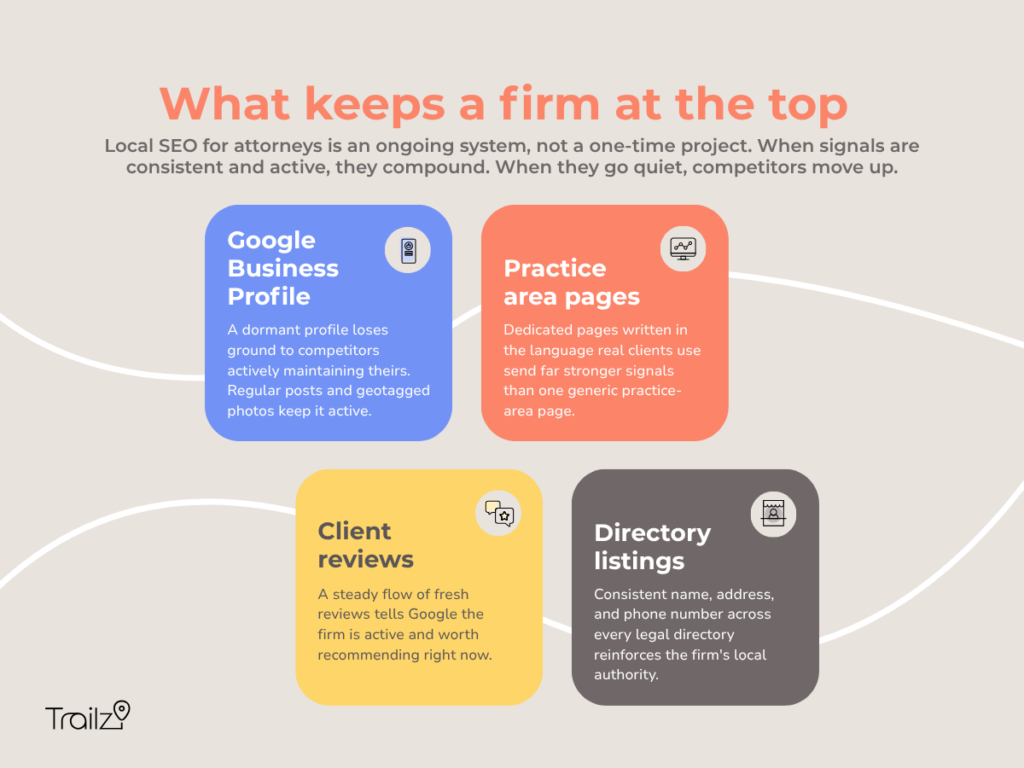
Local SEO marketingfor attorneys is an ongoing system, not a one-time project. The profile, website, reviews, and directory listings all contribute signals Google uses to evaluate authority. When those signals are consistent and active, they compound. When they go quiet, competitors move up.
The firms holding top long-term rankings are usually not the largest in the market. They stayed consistent, kept collecting reviews, and kept their presence current.