


For many small business owners, a website is a fixed cost—a digital checkmark that proves the company exists. It might look professional, but it sits passively, failing to contribute to growth. By treating your website as a static brochure instead of a dynamic, revenue-generating asset, you are leaving a huge amount of intelligence and money on the table. The reality is that most websites are either outdated or, even if modern, are unequipped to be the powerful conversion tools they could be.
This guide gives you the clear, two-stage roadmap I use with my clients to transform a passive website into a scalable customer acquisition strategy. The journey is logical and powerful. It begins with the foundational step of understanding your website traffic—learning what groups of visitors are doing. From there, we progress to the high-impact stage of actively pursuing website conversions by identifying your most valuable anonymous visitors and turning them into tangible leads.
This strategic evolution is how your website stops being an expense and starts generating revenue. Are you ready to ask more of your website?
The Status Quo: The Unoptimized Website and Its Missed Opportunities in Your Customer Acquisition Strategy
Before you can build a growth engine, you must first diagnose the current state of your digital presence. For most small businesses, the website is an unoptimized and passive asset. It functions like an “advanced business card”—it provides information but fails to capture the immense value of the traffic it receives. This lack of optimization means you have virtually no insight into your site’s performance.
This lack of visibility leaves you with a significant blind spot, forced to guess whether your marketing dollars are actually working. You know people visit your website, but most “leave without a trace,” turning into anonymous site visitors who disappear back into the vastness of the internet. This stream of anonymous traffic represents a cascade of missed sales opportunities within your broader customer acquisition strategy. Every visitor who shows interest but doesn’t fill out a contact form is a potential customer lost, directly impacting your bottom line.
The key missed opportunities include:
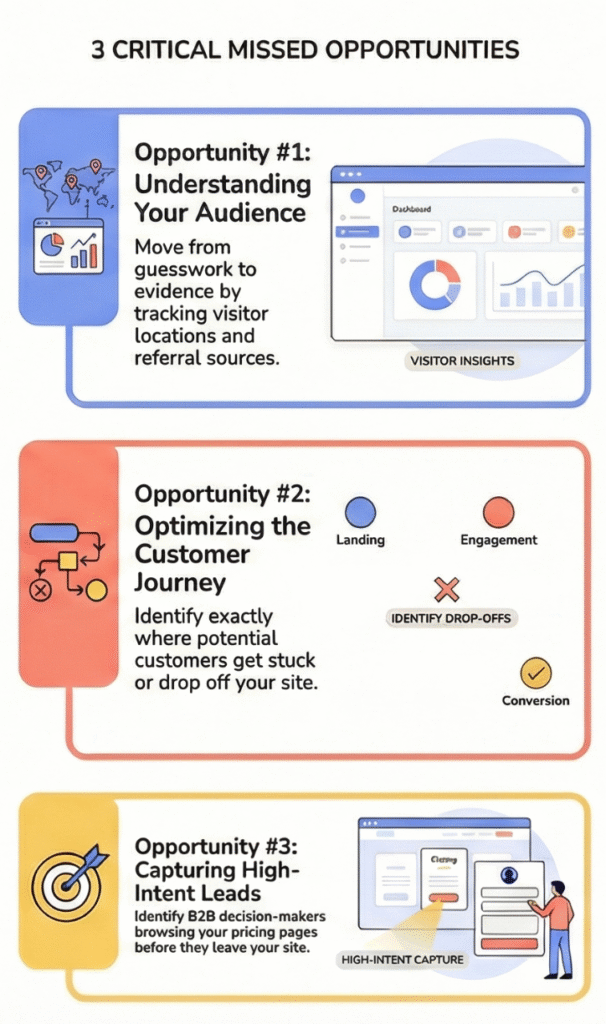
- Missed Opportunity #1: Understanding Your Audience Without analytics, you have no data on who your visitors are. You cannot answer basic but critical questions: Which countries or cities are my visitors from? What pages are they most interested in? How did they find my site—was it a Google search, a link from YouTube, or a social media post? Without this data, your marketing strategy is based on guesswork, not evidence.
- Missed Opportunity #2: Optimizing the Customer Journey An unoptimized site means you are “flying blind.” You are unable to see where potential customers are getting stuck or dropping off. For an e-commerce store, this could be a high abandonment rate between viewing a product and adding it to the cart. For a service business, it might be a confusing navigation path that prevents users from finding the contact page. You cannot fix problems you cannot see.
- Missed Opportunity #3: Capturing High-Intent Leads This is perhaps the most critical failure. High-value B2B visitors—decision-makers, CEOs, and sales managers—are browsing your services and pricing pages. They are showing clear buying intent, but if they don’t fill out a form, their interest remains unknown to you. You lose the chance to proactively engage with a prospect who has already qualified themselves by visiting your site.
These missed opportunities represent a constant leak in your sales funnel. The first step toward plugging that leak is to become aware of what’s happening on your website by finally looking at the data.
Stage 1: Building the Foundation with Web Analytics
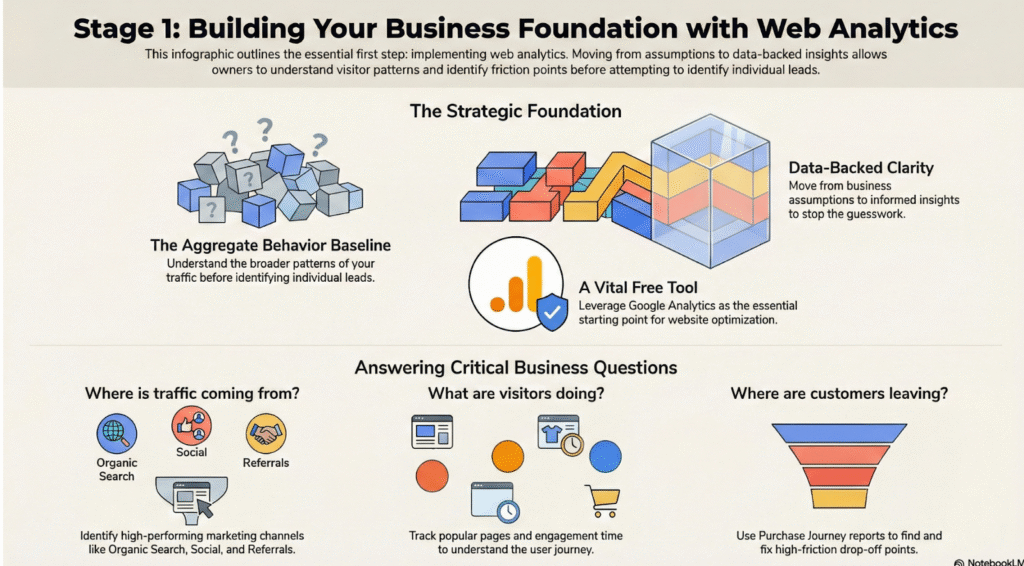
The essential, foundational first step in building a modern customer acquisition strategy is implementing Google Analytics. It is a “vital free website Analytics tool” designed specifically to help you understand the aggregate behavior of your visitors. Before you can identify individual leads, you must first understand the broader patterns of your traffic: the what, where, and how of user interaction.
For a small business owner, the core value of Google Analytics lies in the clarity it provides. It moves you from assumptions to data-backed insights by answering a few fundamental questions:
- Where is my traffic coming from? Google Analytics breaks down your acquisition channels, showing you precisely how people find you. You can see how much traffic comes from Organic Search (users searching on Google), Referral (users clicking a link from another site like YouTube or Reddit), Organic Social, or Direct (users typing your website address directly into their browser). This tells you which marketing channels are performing best.
- What are my visitors doing on my site? You can see which of your pages are the most popular, giving you insight into what content or products resonate with your audience. Metrics like “average engagement time” show you how long users are spending on those pages, indicating their level of interest. This helps you understand the overall user journey from entry to exit.
NOTE: For businesses that want deeper visibility into how users actually behave on a page, tools like Hotjar by Contentsquare can add another layer of insight. Heatmaps and session recordings make it easier to spot friction points that traditional analytics reports may not immediately reveal.
- Where am I losing potential customers? Analytics is incredibly powerful for identifying friction points. For an e-commerce site, the “Purchase Journey” report shows exactly where users drop off. A report might show that 1,900 people viewed a product, but only 114 added it to their cart—a significant drop-off that signals a problem on that product page that needs to be fixed.
The primary benefit of this stage is clear: Google Analytics provides the data-driven insights needed to stop guessing and start making informed decisions. You can optimize your marketing spend, improve underperforming web pages, and fix broken conversion funnels. With this foundation of ‘what’ and ‘where,’ you’ve built the data backbone of your customer acquisition strategy. Now, it’s time to get aggressive and answer the most important question: ‘who are my most valuable visitors?’
Stage 2: From Anonymous Data to Actionable B2B Leads
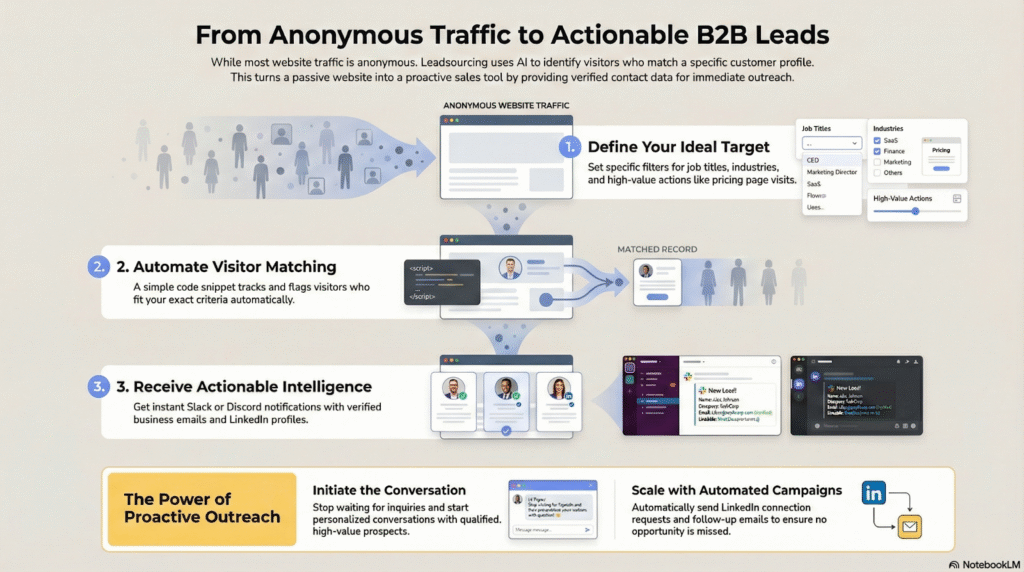
Once you have a foundational understanding of your website traffic, you can make the strategic leap from analyzing anonymous trends to identifying specific, high-value potential customers. This is where a specialized tool like Leadsourcing comes in, designed to turn your website traffic into B2B leads with AI. It closes the loop by de-anonymizing the most promising visitors who fit your exact customer profile.
The process of identifying these ideal customers is remarkably straightforward and can be broken down into a simple, three-step workflow:
- Step 1: Define Your Ideal Customer First, you set a “target audience” by defining exactly who you want to connect with. This is highly specific. This means you can tell the system, “Only show me CEOs, Founders, or Sales Managers from the Banking or Chemical industries in the US, but only if they visit my pricing page.” You control the filters for job title, industry, company size, and even the specific actions they take on your site.
- Step 2: Identify Matching Visitors After a small piece of code is added to your site (compatible with WordPress, Shopify, and Google Tag Manager), Leadsourcing works “behind the scenes.” It tracks your website visitors and automatically flags any individual who matches the ideal customer profile you’ve defined.
- Step 3: Receive Actionable Lead Details When a qualified lead is identified, you receive an immediate notification via Slack or Discord. You can then log into your dashboard to see the visitor’s complete details, including their name, job title, company, a verified business email address, and a link to their LinkedIn profile.
This capability unlocks the power of proactive, personalized outreach. Instead of waiting for a lead to come to you, you can now initiate the conversation. Leadsourcing even includes an “automated outreach campaigns” feature, which allows you to automatically send LinkedIn connection requests and personalized follow-up emails to these newly identified prospects, saving you time and ensuring no opportunity is missed.
This targeted approach transforms your website into an active component of your customer acquisition strategy.
Strategic Synergy: How Web Analytics and Lead Identification Work Together
It is crucial to understand that these two strategies are not mutually exclusive; they are complementary parts of a comprehensive customer acquisition system. Using only analytics is like having a marketing department with great reports but no sales team to act on them. Using only lead identification without analytics is like having a sales team making calls with no marketing intelligence. True growth comes from synergy. This integrated approach is the difference between siloed departments and a fully integrated revenue team.
The following table clarifies the distinct yet synergistic roles of each tool:
| Feature | Google Analytics (The Macro View) | Leadsourcing (The Micro View) |
| Primary Goal | To understand aggregate website performance and anonymous user behavior. | To identify specific, anonymous B2B visitors and turn them into actionable leads. |
| Core Question Answered | “What are groups of visitors doing on my site, and where did they come from?” | “Who are the ideal B2B prospects visiting my site right now?” |
| Data Type | Anonymous, aggregated data (e.g., 3.5k users, 55% viewed a product). | Identifiable contact data for matched profiles (e.g., name, job title, company, email). |
| Key Insight | Identifies broad trends and optimization opportunities (e.g., high bounce rate on a key page). | Identifies individual sales opportunities in real-time (e.g., a CEO from a target company is on your pricing page). |
| Primary Business Action | Optimize marketing campaigns, improve website content, and fix conversion funnels. | Initiate direct sales outreach, send personalized emails, and connect on LinkedIn. |
| Cost Model | Free to use. | Paid service with monthly lead credits. |
Using both strategies in tandem creates a powerful, systematic approach to growth where broad market insights and individual sales actions work hand-in-hand.
The Result: Your Website as a Customer Acquisition Engine
By implementing this two-stage strategy, the contrast with the starting point becomes stark. The passive “digital brochure” from Section 1 is replaced by an active, intelligent system that is a fully integrated part of your customer acquisition strategy. This transformation delivers tangible outcomes that directly contribute to business growth.
- Data-Driven Decision Making: Guesswork is eliminated and replaced by concrete insights. With Google Analytics, you can confidently invest in the marketing channels that are proven to work by reviewing acquisition reports. You can identify underperforming pages and optimize them for better engagement and conversion, ensuring your resources are allocated for maximum impact.
- Proactive Sales Engagement: The posture of your sales effort shifts from reactive to proactive. You no longer have to wait for prospects to fill out a contact form. With a tool like Leadsourcing, your sales team can proactively engage with high-quality B2B leads who have already demonstrated interest by visiting key pages on your website. This allows you to connect with decision-makers at the peak of their interest.
- Systematic and Scalable Growth: This process is not a one-time fix but a continuous, positive feedback loop. You attract traffic through marketing, analyze its behavior with Google Analytics to refine your strategy, identify the most promising prospects with Leadsourcing, and engage them through direct outreach. The results of that outreach—both successes and failures—provide new data to further refine your targeting and messaging.
This systematic approach is how small businesses can effectively compete in the digital landscape, turning their online presence from a static expense into a measurable and consistent source of revenue.
Building a Smarter Customer Acquisition Strategy
The journey outlined here is a deliberate transformation: from an underperforming website that costs you money to a powerful, two-stage system for understanding website traffic and driving website conversions. By first building a foundation of data with web analytics and then layering on a proactive system for lead identification, you create a true engine for growth.
Your website should be your hardest-working employee. The transformation begins with the first, free step we outlined: installing Google Analytics. It is the foundation of every smart digital strategy. Make the decision today to stop guessing and start measuring. If you’re looking for guidance on building or refining your customer acquisition strategy, you can explore how we approach digital growth at Trailzi.
And if you’d prefer to discuss how this two-stage system could apply specifically to your business, feel free to reach out to our team here.