
Yes, $2,000 a month is enough to hire a marketing company when the budget is spent on a focused strategy at an agency built for small businesses.
The short answer is yes. But small business owners hear “yes” and often stop reading, which is where the trouble starts.
A $2,000 monthly budget looks straightforward on paper. Pick an agency, sign a contract, watch the marketing happen. In practice, the businesses that spend $2,000 a month and see real growth are doing three specific things differently than the ones that spend the same amount and see almost nothing. It’s not always about the amount. It’s more about the decisions around it.
Ask for the Outcome, Not the Activity
Here’s an example. A small business came to a marketing agency with a $1,500 monthly budget. The business was asking for a website refresh and a blog to fix its low traffic. That’s what they asked for. What they wanted was a steady stream of new leads every week. They didn’t say that. And the agency didn’t ask.
The agency delivered what was requested. New site, new blog, aggressive SEO on the content. Within months, web traffic was up. Leads did come in, but not the weekly flow of high-intent buyers the owner had been picturing. The owner was frustrated. The agency was confused. Both sides had done their part, and the outcome still felt like failure.
That’s what happens when the strategy was never defined. If the conversation had started with “we need aggressive lead generation” instead of “we need a new website,” the agency would have proposed something different. Perhaps a targeted paid campaign, a stronger conversion mechanism, or a specific outreach path.
And that’s why words matter here. “Leads” means something different to every business owner, and defining what it means before the work starts is what separates a good engagement from a frustrating one. Before a first meeting with an agency, a small business owner should have answers ready for:
- How many leads. Ten a month or a hundred?
- What kind of leads. Warm leads from search, or high-intent buyers ready to close?
- When the leads should start. A month in? A quarter? Longer?
A good digital marketing agency will ask these questions. The owner who walks in with the answers gets a better strategy from day one.
Why Doing Fewer Things Produces Better Results
The second common mistake is spreading a $2,000 budget across too many activities.
Small business owners often assume that more marketing channels mean more results. They ask the agency to run social media, refresh the website, start a blog, launch email campaigns, manage the Google Business Profile, and maybe run a small ad budget. On a $2,000 monthly budget, none of those activities gets enough investment to actually produce results. The budget gets diluted, and nothing moves the business forward.
A better approach is a focused marketing path. Two or three coordinated activities that build on each other, backed by enough budget to execute well. And the specific path depends on the business. A home service company needs something different than a professional services firm (but the principle is the same). Depth beats breadth at this budget level.
When talking to a marketing agency, the right question is: “What’s your recommended marketing path for a business at this budget?” An agency that has a clear answer, based on what they’ve seen work at similar budgets, is thinking about the problem the right way. An agency that offers to do everything at once, at any budget, is not.
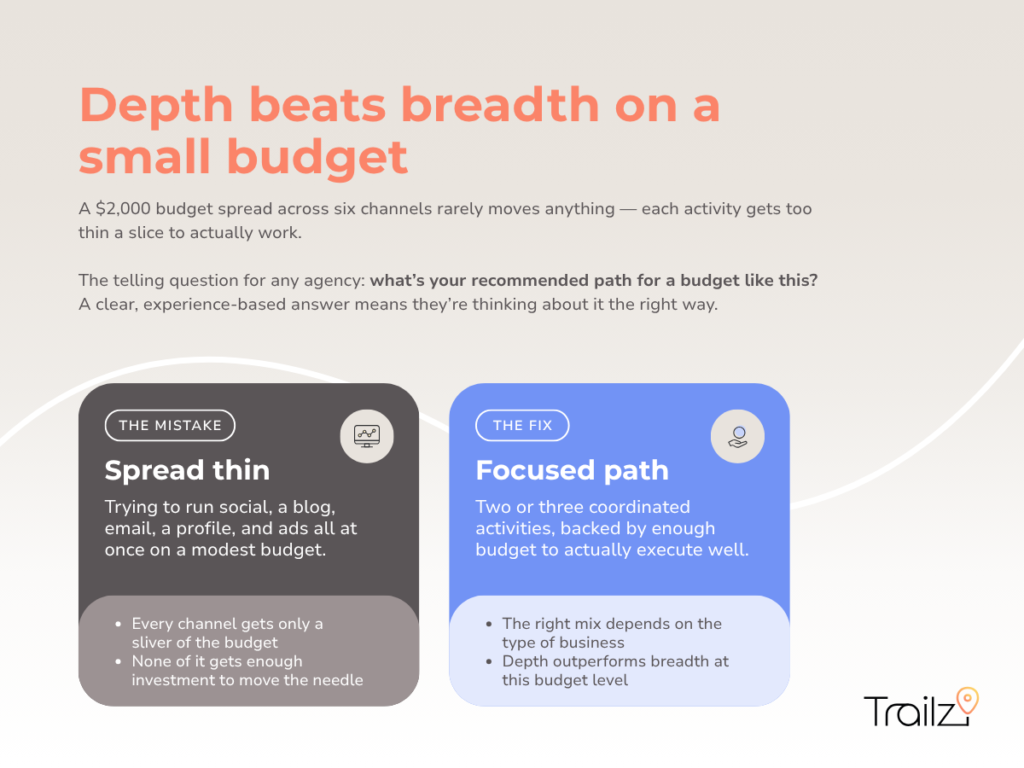
a few coordinated activities to actually move the needle.
The Agency Has to Be Built for Small Business Budgets
The third factor is agency fit. A $2,000 monthly budget is meaningful money for a small business. At an agency that primarily serves clients with $10,000 monthly budgets, it’s a rounding error.
That mismatch might mean:
- The account gets less senior attention
- The strategy gets less thought
- The work gets handed to junior team members while the senior staff focuses on the bigger clients.
None of this is because the agency is bad. It’s because the economics don’t work. The agency’s cost structure was built for a different kind of client, and a $2,000 account can’t support the same level of engagement the larger accounts get.
A small business marketing agency operates differently. Their pricing is built around small business budgets. Their team is structured for small business accounts. Their strategy playbook is designed for what small businesses need, not scaled down from work built for larger companies.
The right question to ask on a first call is straightforward: “Who are your typical clients, and what budgets do they usually spend?” If most of the answers are well above $2,000, it might not be the best fit for local small businesses.

What This Looks Like in Practice
A $2,000 monthly budget can generate real results for a small business — but only when the strategy is clear, the activities are focused, and the agency is built for a budget at that level. All three have to be true. Getting two out of three usually produces disappointment.
For small businesses in the Denton growth corridor — including Argyle, Roanoke, Justin, and Northlake — Trailzi offers flat-rate marketing services at $2,000 per month. The flat-rate model provides predictable pricing with no scope creep, and the monthly activities within each marketing path get customized based on the business’s growth patterns and analytics. The goal is focus and realistic expectations. This helps small business owners understand exactly what their investment produces and how the plan will evolve over time.