
A business owner should expect predictable monthly pricing in exchange for a defined scope of work, with clear boundaries on what’s included and what isn’t.
Marketing agencies usually bill by retainer, project, or hour. Each of those models has trade-offs. Retainers shift as scope grows. Hourly billing rewards agencies for taking longer. Project-based pricing works well for one-off engagements but not for ongoing marketing.
Flat-fee models take a different approach. The business pays the same amount each month, and the agency delivers a defined set of activities in return. The model appeals to small business owners for obvious reasons. And that’s because of their predictability. No surprise invoices, which makes for easier budgeting. But knowing what to expect from a flat-fee agency, and what not to, is what makes the model actually work.
Predictable Pricing With No Surprises
The first thing a business owner should expect from a flat-fee marketing company is predictability. Same amount each month. No scope creep. No surprise line items for a phone call, an extra revision, or a routine change request.
That predictability is what makes flat-fee marketing attractive for small business budgets. When the marketing spend is a known number, the rest of the budget planning gets easier. Marketing ROI becomes clearer because the input side is stable. A small business owner can look at what they’re spending and what they’re getting and make honest decisions about whether the investment is working.
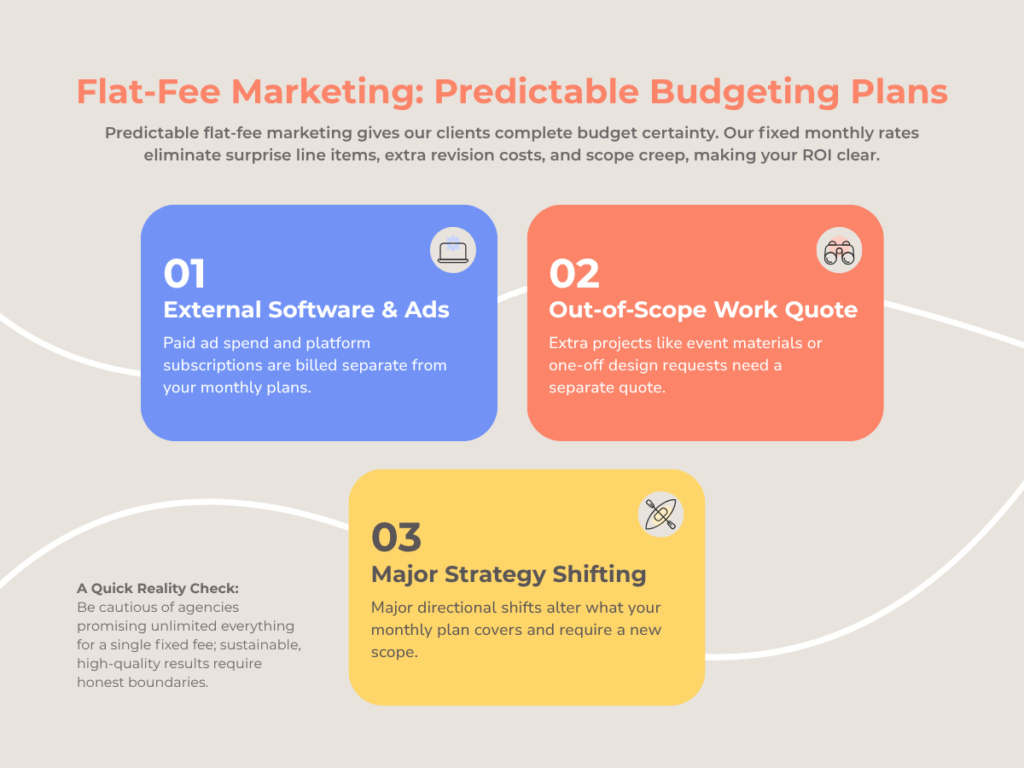
There are a few things flat-fee pricing typically doesn’t cover, and knowing this in advance prevents frustration later:
- Third-party costs like software subscriptions and paid ad spend are usually separate.
- On-demand work outside the agreed scope, such as event materials or one-off design requests, gets quoted separately.
- Major strategic shifts may require a new scope conversation if they change what the monthly work covers.
NOTE: An agency that promises unlimited everything for a fixed monthly fee usually can’t deliver on it for long.
A Defined Scope of Work Focused on Results
The other side of predictable pricing is a defined scope of work. A flat-fee agency can’t afford to do infinite things for a fixed price, so they focus on the specific activities that move the business forward.
So instead of a scattered list of tactics — a little social media, a little SEO, a little email, a little paid, all under-resourced — the monthly work concentrates on a coordinated set of activities that reinforce each other. The result is that each dollar goes further because the effort compounds.
Trailzi structures this as four defined paths at $2,000 a month, each targeting a specific business challenge — local visibility, website conversion, lead generation, or a strategic reset. That kind of structure is common in flat-fee models. The names vary by agency, but the underlying idea is the same: a curated set of activities designed around the owners’ goal, executed consistently month after month.
Within the scope, there’s usually room for adjustment. What the analytics show and how the business is growing shape which specific activities get prioritized in a given month. The scope isn’t rigid, but it is defined. A business owner asking a flat-fee agency to also handle a fifth unrelated project every month will either get charged separately or get pushback — both of which are reasonable responses.
Transparent Boundaries and Honest Conversations
The third thing to expect from a good flat-fee agency is honesty at the boundaries. Requests will come up that fall outside the scope. Some months, a business will need something extra. How the agency handles those moments says a lot about the relationship.
A well-run flat-fee agency is transparent about the boundaries:
- Requests outside the scope get named and priced separately rather than absorbed silently.
- Scope changes are discussed openly so the business owner understands what’s shifting and why.
- The monthly deliverables stay consistent even when one-off requests are being handled on the side.
Traditional retainer models often absorb small requests silently until the business owner realizes they’re paying a rising fee for work they never explicitly agreed to. Flat-fee agencies that are doing the model right handle those moments in the open — which usually means clearer expectations, fewer surprises, and a more stable working relationship over time.
The trade-off is that a business owner has to be willing to have those conversations. Flat-fee pricing works best when both sides are aligned on what the scope covers and what happens at the edges of it. Agencies that pretend the boundaries don’t exist tend to disappoint. Agencies that name the boundaries clearly tend to deliver.

Deciding If Flat-Fee Is the Right Fit
The flat-fee model isn’t right for every business. A business that needs an agency to handle anything and everything without clear scope will find flat-fee too constrained. A business that wants highly custom project work with variable scope month to month will find flat-fee too rigid.
For a small business that wants predictable pricing, focused execution, and honest boundaries on what’s included, flat-fee usually fits well. The predictability makes budgeting easier. The scope makes results more likely because the work is focused instead of scattered. The transparency at the boundaries builds a stronger working relationship than the alternative.
The right question for a business owner evaluating a flat-fee agency isn’t whether the price is low enough. It’s whether the scope of work matches what the business actually needs and whether the agency is transparent about what happens when needs shift. Those two answers determine whether the model will produce results or frustration.