A website gets traffic but no leads when it’s missing clear messaging, strategic calls to action, and a customer journey built to guide visitors.
Most small business owners assume more web traffic equals more business. It doesn’t work like that. A website can pull in thousands of visitors a month and produce almost no leads, while another site with a fraction of the traffic consistently generates real customers. The difference isn’t just the volume coming in. It’s what happens after the visitor arrives.
Why More Web Traffic Doesn’t Always Mean More Leads
Web traffic and lead generation are two different goals. They get measured differently, and they need different strategies.
Web traffic is about awareness. It’s the number of people who have visited your site. Lead generation is about action. It’s the count of people who showed up and then did something (i.e., filled out a form, called the business, booked an appointment, or signed up for a newsletter).
A small business focused only on driving traffic often ends up with web traffic going up, without actually generating leads. The site gets visitors. The visitors leave. Nothing happens. Meanwhile, the business owner is paying for the traffic, or investing time in SEO, content, and ads to keep it growing.
The traffic isn’t the problem. What’s missing is the bridge from visitor to lead, and that bridge is built on the website itself.
What Turns Traffic Into Leads on a Small Business Website
A website that converts visitors into leads is built differently from one designed only to look professional. Eight things separate the two:
- The site is built for two audiences. Customers need to understand the business, and search engines and AI need to understand it too.
- Visitors know what the business does within seconds of landing. Clear, plain language up front beats a clever tagline every time.
- The brand message speaks directly to the target customer. Language that names the customer’s actual problem outperforms generic copy aimed at a broad audience.
- Calls to action are strategic. Each CTA appears at the moment a visitor is ready to act, with language that invites rather than pressures, because web conversion happens at the point of action.
- The target audience is understood in real detail. The website only works if the copy, the offers, and the journey reflect a real person with real needs.
- Visitor behavior is observed, not assumed. Tools like Hotjar and TruConversion show where visitors scroll, pause, and leave, revealing what’s working better than any internal opinion.
- The customer journey is mapped and adapted. Every page leads somewhere on purpose, and when something stops working, the journey gets adjusted.
- Forms and contact options are placed where they convert best. Decision points convert far better than the bottom of the page.
Those eight points help a website convert visitors the first time they land. But what about visitors who don’t take action on that first visit? That’s where retargeting comes in. A visitor who scrolls, looks around, and leaves is usually gone for good unless something brings them back. Retargeting keeps the business in front of that visitor across other sites and platforms after the initial visit, and for small businesses, it’s often the difference between a site that produces occasional leads and one that produces them consistently.

What to Do When the Site Still Isn’t Converting
If a small business website is pulling traffic but not leads, the next step is a website audit. Most marketing agencies offer audits for free, even to non-customers, and walk through what they found in a follow-up session.
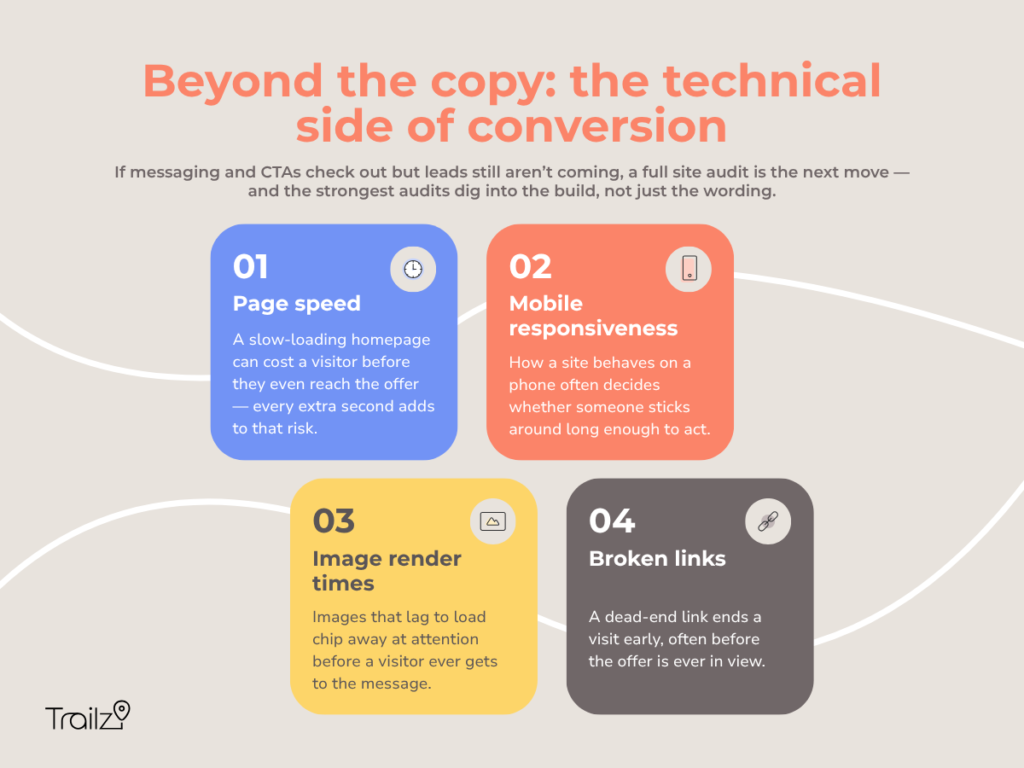
But a good audit goes beyond copy and calls to action. Website development factors like:
- page speed
- mobile responsiveness
- image render times
- and broken links
These affect whether a visitor stays long enough to take action. A site that takes five seconds to load loses visitors before they ever see the offer.
Not every fix is worth the same investment. Some changes — simplifying a form, repositioning a CTA, fixing a slow-loading homepage — produce outsized returns, so the audit recommendations should be weighed against the broader marketing budget.
Others are nice-to-have improvements that can wait. A good marketing partner helps prioritize so the dollars go where they’ll move the needle most.