
The best marketing strategy for a photography business combines a defined niche, a portfolio website, Google Business Profile, reviews, and social media.
Photography is a referral-heavy industry, but referrals alone rarely fill a calendar. The photographers who stay booked treat marketing as a system. And that system starts before a client ever opens Google and follows through until the booking confirmation lands. A clear niche, a portfolio built for conversion, and consistent visibility across local search and visual platforms together do more than any single tactic.
Why Does Choosing a Photography Niche Strengthen the Marketing Strategy?
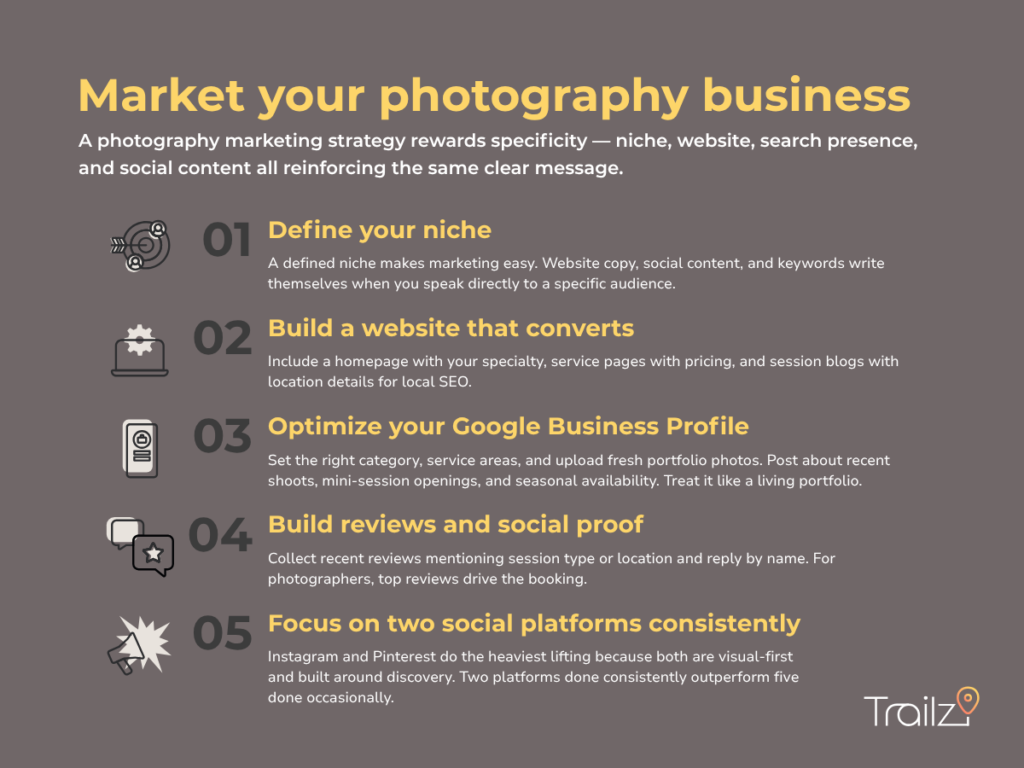
Photographers who try to shoot everything — weddings, newborns, headshots, real estate, events — tend to compete with every other photographer in the area. A defined niche narrows the competition. It also sharpens every piece of marketing that follows. A wedding photographer can speak directly to engaged couples about venue experience and timeline planning. A brand photographer can speak directly to small business owners about visual identity and product launches. That means the website copy, social content, and search keywords all get easier to write when the audience is specific.
A niche also strengthens local search performance. Google ranks photographers more when the profile, service pages, and reviews all reinforce the same specialty rather than spreading thin across categories.
How Does a Photography Website Convert Visitors Into Bookings?
A photography website should not just be a portfolio gallery. It is also the closing tool. Visitors who land on the site have usually already decided they like the work — what they’re checking now is whether the photographer feels professional, reliable, and worth their budget.
The pages that matter most:
- A homepage with a clear specialty, price range indicator, and recent work
- An about page that establishes the photographer’s experience and approach
- Service pages for each shoot type with pricing, deliverables, and timeline
- A contact page that explains what happens after an inquiry comes in
- Recent session blog posts with location details that double as local SEO content
Photographers who pair strong work with a clear site convert significantly more inquiries than those relying on Instagram alone.

What Role Does Local Search Play in a Photography Marketing Strategy?
Around 90% of local searches happen on Google, and 80% of clicks land on the top five listings. A photographer who isn’t visible in those spots loses booking opportunities before the conversation even begins.
These are the signals that matter most for photography businesses:
- A Google Business Profile with the right category, service areas, and fresh portfolio uploads
- Service pages on the website written for specific cities or neighborhoods
- Reviews mentioning session type, location, and photographer name
- Posts about recent shoots, mini-session openings, and seasonal availability
Photographers who treat the Google Business Profile like a living portfolio outperform those who set it up once and walk away.
How Do Reviews and Social Proof Drive Photography Bookings?
Booking a photographer is a trust decision. Clients are handing over weddings, newborn sessions, family milestones, and headshots that matter to their careers. And that means, reviews carry more weight in photography than in almost any other local service category.
What converts:
- Recent reviews from the last few months
- Specific mentions of session type or location
- Photos attached to reviews when clients are willing
- Owner responses to every review, thanking clients by name
Roughly 74% of local searchers buy within 24 hours, and for photographers, that decision almost always comes down to the reviews waiting at the top of the listing.
Which Social Platforms Belong in a Photography Marketing Strategy?
Instagram and Pinterest do the heaviest lifting for photographers because both are visual-first and built around discovery. TikTok works for photographers willing to show personality and process. Facebook still drives referrals for wedding and family photographers in particular through local community groups.
The strongest social strategy for photographers usually focuses on two platforms done consistently rather than five done occasionally. Posting full sessions, behind-the-scenes content, and short-form video featuring real client moments tends to outperform polished promotional posts.
A photography marketing strategy rewards specificity. The photographers with the strongest businesses are the ones whose niche, website, search presence, and social content all reinforce the same clear message.