A small business builds trust quickly in Argyle by partnering with HOAs and using its website, Google profile, and social media to signal real local connection.
Argyle was a quiet, rural town for most of its history. Trust took years to build, and that worked. People knew each other, recommendations passed during school events, and a business with a decade of local presence had a reputation that did the heavy lifting.
But today, the population has grown by more than half since 2020. Large master-planned communities like Harvest and Canyon Falls are bringing in hundreds of new families every year. A business that’s been in Argyle for ten years and a brand-new competitor look about the same to a family that moved in last month.
Why Trust Building in Argyle Looks Different Now
The classic small-town trust model assumes time. A new resident moves in, asks a neighbor for a recommendation, hears the business name, and joins the existing word-of-mouth network. That still works, but most Argyle small businesses don’t have years to wait. Hundreds of new families are arriving every year. And those families make early decisions about local providers in their first few months.
What works in this moment is showing up where new residents already are, both in the community itself and online.
How HOA Partnerships Connect a Business to New Residents
The fastest way to reach new residents is through the communities they’ve already moved into. Master-planned communities like Harvest and Canyon Falls have HOAs, lifestyle directors, programmed events, and active social calendars. New residents plug into that infrastructure within days of moving in.
A business that partners with a community’s HOA gets introduced to dozens of new families through a channel they already trust.
- Sponsoring an event
- Providing a service at a community gathering
- Running a workshop at one of the community spaces
All of these strategies could work. It’s because they’re not cold outreach. It’s a recommendation that comes through the community itself.
For example: A small HVAC company sponsors a summer cookout at the Harvest community lawn during the first heat wave. Families show up, meet the team, get a maintenance checklist for new homeowners, and the business becomes the natural call when something breaks. The trust is borrowed from the community, then earned through the work.
Harvest is a 1,200-acre community that runs hundreds of programmed events each year. Canyon Falls covers another large footprint with its own clubhouse and active programming. Both communities straddle Argyle and Northlake, which means partnering with either one reaches new residents across two cities at once.
How a Website Shows Local Connection
Websites that build trust quickly with new residents do a few specific things:
- Name the actual neighborhoods served. Mentioning Harvest, Canyon Falls, Waterbrook, Lakes of Argyle, and other communities tells a new family the business knows where they live.
- Show local events and community involvement. A page featuring the business at Argyle ISD fundraisers, community festivals, or Harvest’s lifestyle events signals real participation, not just a local mailing address.
- Welcome new residents. A discount window targeted to families in their first 90 days in Argyle signals that the business pays attention to new arrivals and gives them a clear reason to choose this business over a competitor.
- Include a guide to local connection points. A simple list of nearby parks, schools, community events, or favorite local spots helps the new resident and signals the business knows Argyle from the inside.
- Use real local photos. Photos of the actual storefront, team, and customers in Argyle. Stock photos read as generic.
How a Google Business Profile Signals Community Connection
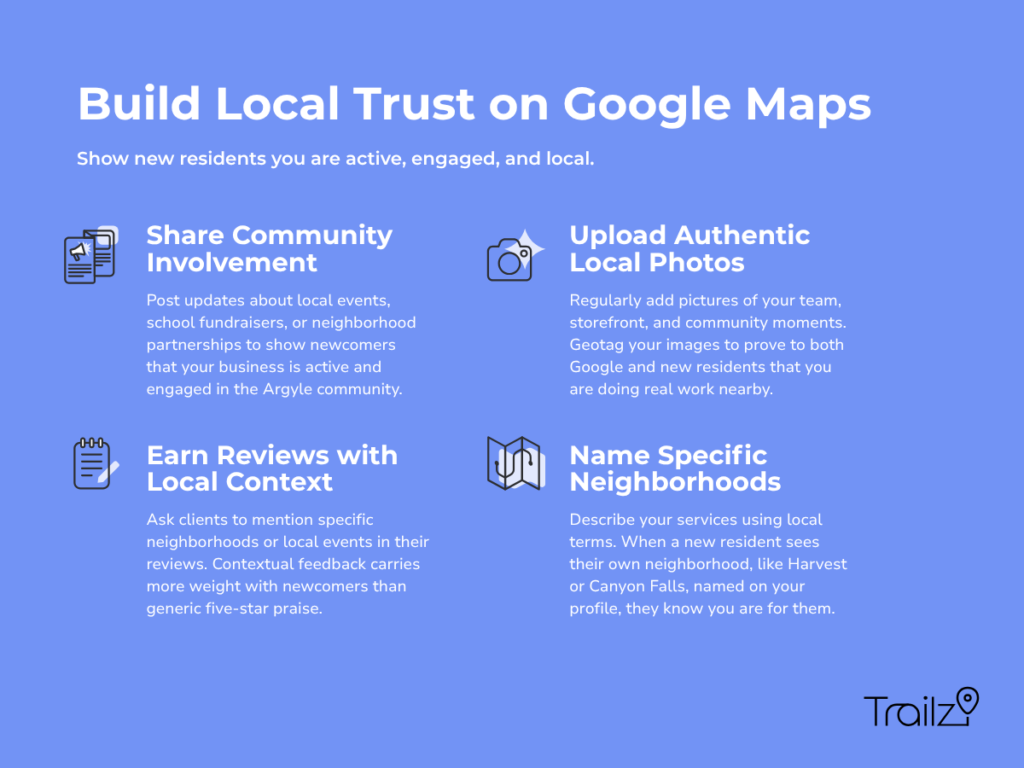
When a new resident searches for a local business in Argyle, the Google Business Profile is usually the first impression. A profile that’s just a name, address, and phone number doesn’t build trust. So here are some trust signals to focus on:
- Posts about local events and community involvement. A business posting about a recent Harvest event, an Argyle ISD fundraiser, or a Canyon Falls partnership looks active and engaged.
- Photos that show real local moments. Storefront, team, community events, customer moments. Refreshed regularly and geotagged when possible.
- Reviews that mention specific local context. Reviews referencing specific neighborhoods or events carry more weight than generic praise.
- Services described in Argyle-specific terms. A new resident in Harvest who sees their own community named on a profile immediately registers that this business is for them.
The specifics of optimizing a Google Business Profile for local search ranking are covered in more detail in the related article on why a business might not be getting found online in Argyle. The trust angle here is separate. It’s about how the profile reads to a new resident who’s already found it.
How Local Social Media Creates Curiosity for New Residents
Social media is another channel where new residents form first impressions before they ever call. And in this channel, the businesses winning at trust quickly are showing real local personality.
What that looks like:
- Photos and short videos from community moments. Setting up at a Harvest event, sponsoring a school activity, behind-the-scenes from a recent local job.
- Welcome content for new residents. A simple post like “Just moved to Argyle? Here are three things we wish someone had told us during our first month” creates curiosity and gives a new family a reason to follow.
- Local Argyle content that has nothing to do with selling. Sharing news about a new local restaurant, celebrating an Argyle ISD championship, pointing followers toward a community event. These posts get shared in neighborhood Facebook groups and Nextdoor threads.
- Stories about local customers, with permission. A short post about a family helped recently, named by neighborhood when appropriate, builds recognition for other residents in that community.
Social media that’s a sales feed loses to social media that feels like a neighbor who happens to run a business.
What This Looks Like Together
These four create a system that works because each piece reinforces the others.
A new resident hears the business name at a Harvest community event. They search for it later that week. The Google profile shows photos of the same event, plus reviews from other neighborhood families. They click through to the website, which names their community and offers a welcome discount. They follow the social account because the recent posts feel like they’re written by someone who actually lives in town. By the time they need the business, they already trust it.
That kind of compounding trust used to take years in Argyle. For businesses that don’t have years, building the four pieces deliberately gets the same result much faster.